Showing posts with label cars. Show all posts

Thursday, June 25, 2009

RG's break, Day 1: Don't Tase me, bro!

On my first day off, I went for a bike ride, took some photos...

...and wrote a letter to the NCC:
Hello,

I spoke with Sarah around 16h00 about the traffic re-routing situation on Colonel By Drive just West of Bank Street, where a vehicle had plunged into the Rideau Canal this morning.

My complaints were/are that the entire grassy area between the Driveway and the canal was closed off with police tape, and pedestrians and cyclists were told by an RCMP officer halfway through the cordoned off zone to walk/bike on the roadway.

As you can see in the attached photo taken at 14:23:

  • the South side of Colonel By Drive has an embankment that prevents people from walking on that side

  • While pedestrian traffic is barricaded, motor traffic is able to travel completely freely and, aside from the flashing lights on the police/conservation vehicles parked on the grass, there is nothing (i.e. signage, officers directing traffic) suggesting they need to slow down.

  • Colonel By Drive is curved at this part, lowering visibility for westbound motorists who may not expect to share the road with pedestrians or cyclists (and for eastbound motorists to give more room for westbound motorists passing cyclists/pedestrians)

  • There is a long stretch between the near ribbon of police tape and the far one, with nothing to indicate to pedestrians and cyclists where they are expected to go

  • The police officer is stationed halfway between these two ribbons and was angrily accosting every pedestrian and cyclist who walked on the grassy side of the curb, as if it were obvious not to walk on the grass

  • Because the police officer is only confronting pedestrians/cyclists once they reach him, one sees others in ahead walking toward him on the grass, and one assumes that it is therefore permissible to be there.
It would be quite a tragedy if a pedestrian or cyclist were to be injured in a collision as a result of this officer telling them to walk on the unimpeded roadway.

As mentioned on the phone, I think the first priority should be to prevent risk of injury to bystanders, and that would mean putting up pylons, barricades, or police tape providing a safe channel for pedestrians and cyclists to walk on the roadway during the course of the investigation.

Thank you for your prompt attention to this matter. I hope this suggestion is incorporated into officers' standard procedures for such pathway closures.

Sincerely
&c.
The mountie was particularly aggressive to me, because I wasn't just passing through, I had stopped and was taking photos. "What are you doing?" he snapped at me as I was walking back toward Bank Street. "I'm taking photos," I replied casually. I figured that if those two people with much nicer cameras than mine could be much further into the grass (right behind the metal barricade in the photo below), I could stand by the curb and take a few shots of my own.

"Well take your photo and get out of here," he shouted.

"Je l'ai déjà prix!" I changed back to him, still walking away.

After a few more steps, I stopped, looked back to offer him a glare (he was busy grumbling at another cyclist), turned back away, took this photo of his car, and decided to continue my departure at a much more casual rate.

It was much later when I thought of "Don't tase me, bro!" as an alternate retort.

I understand that nobody was injured in the crash, but an investigation is ongoing and divers are still at work to ensure that the vehicle isn't leaking any fluids.

- RG>

Friday, June 19, 2009

On-street rail: a century-old non-problem

In reading the background papers for the LRT Technology Forum tomorrow morning, much ado is made about segregated corridors. That is to say, if you don't put rail in a tunnel or up in the air, you need to put up fences to keep pedestrians from crossing the line, or else chaos will result.

So it's interesting that I came upon a video of Vancouver Streetcar traffic in 1907, which clearly shows pedestrians, cyclists and horse-drawn carriages crossing the streetcar tracks with no difficulty or conflict. (Nor, I might add, signals to tell them when and where to cross)

If they put light rail along the Western Parkway (emphasis on "if"), would tracks with a train passing promptly every 30 or 60 seconds really be as dangerous to cross as, say, the four lanes of constant car and bus traffic already there?

Why don't we have fences along, say, Carling?

Yet another bias in our car-based culture. Cars and buses are safe because they're normal, trains are dangerous because we're not used to them.

- RG>

Thursday, February 05, 2009

SCAN: Split Communities and Neighbourhoods?

Via Blogawa, I saw a post by A. on Please Pick-Up Your Socks that there would be a meeting about Safer Communities and Neighbourhoods ("SCAN") legislation, which is being proposed in Ontario by our local MPP, Yasir Naqvi. The meeting was held tonight (Thursday, February 5, 2009) at the Ottawa Public Library main branch.

The event was organized by a group called People Against SCAN (PeopleAgainstSCAN.com), and consisted of a panel of five speakers, including Naqvi, Cheri DiNovo (NDP MPP for Parkdale-High Park; Naqvi and DiNovo pictured below), Yutaka Dirks (Advocacy and Outreach Coordinator, Advocacy Centre for Tenants - Ontario), Anne Levesque (Lawyer, Clinique juridique francophone de l'est d'Ottawa), and Tara Lyons (Executive Director, Canadian Students for Sensible Drug Policy).

Kudos are in order for Mr. Naqvi coming out to an event organized by a group whose sole purpose is to oppose legislation he is sponsoring, and also for being willing to meet with many of the individuals and groups represented at the meeting who oppose his bill. But just showing up won't win my support.

Before the event, I had a chance to read over some information about the Orwellian-titled SCAN bill on the People Against SCAN's website, particularly This memo detailing areas of concern of the bill. Looking through that document was frightening. The mere fact that a tenant can be evicted without having a right to properly defend themselves (as is the case with SCAN legislation in other jurisdictions) is enough for me to oppose it outright. I don't care what your bill is designed to do, if it skirts due process, I oppose it--didn't we learn that already with Bush, Cheney, Rumsfeld and Gonzales?

There were definitely a decent representation of people at the meeting in favour of the legislation. Most cited chronic crack houses as the problem they want this legislation to solve--houses where illegal activity takes place (even though the reach of the bill goes beyond criminal activity)--but I am not convinced, as they are, that this legislation will actually solve their problems. So you shut down a house filled with crack addicts. They're not all of a sudden going to get un-addicted because they were evicted.

Moreover, even if it were to solve the problems cited by its proponents in the audience, SCAN would impact others in the community in ways that don't seem to concern the proponents.

You can download a PDF of the bill here and see for yourself what it says.

One section that was raised as a concern was section 20. Section 20 starts out by saying that the municipally-appointed Director of Safer Communities and Neighbourhoods must make a "reasonable effort" to make sure that evicted residents have alternate accommodation. Now, I don't like ambiguous words like "reasonable" to begin with, but the section continues to say that it "does not apply to a resident who the Director reasonably believes caused or contributed to any of the activities in respect of which the order that requires the residents to leave was made."

So once the eviction takes place, the Director can let them go out in the cold so long as the Director "reasonably believes" that the people caused or contributed to activities which triggered the SCAN legislation--activities which don't have to be illegal, simply which "adversely affect" the neighbourhood--such as sniffing glue or gasoline in one's home (read the law--it actually mentions glue!).

The bill has passed second reading, but is in committee and will likely not survive there, which is a good thing in a way.

But in another way, it's a pity, because the community members who wanted SCAN wanted it because there were problems in their community and they're banking on it getting passed. But they asked for legislation that does far more than is reasonable, and as such it will get shot down and these community members will be back at square one with no resolution to their legitimate problems.


On my way home from the meeting, I came across a car whose alarm was going off. This was pretty late at night, and the streets were empty. As someone who is concerned about his neighbourhood, I felt compelled to do something about it. My cell phone's battery had run out (grr... stupid thing won't even last one full day and it's less than a year old...), so my initial reaction to phone Bylaw to make a noise complaint was not an option. But a dead cellphone battery wasn't going to stop me.

I started by leaving a note on the windshield wiper, which read "If you're not going to respond to your car alarm going off, then TURN IT THE FUCK OFF!!! (P.S. Your radio is still on)"

After leaving this note under the windshield wiper, I took down the plate number, time and location on my notepad so I could report it when I got home if I felt like it. But as I was writing it, a man walked up to the car. I established that he was the owner, and told him that the car alarm was going off, even if I just walk in front of the car.

And the guy was genuinely concerned. He was concerned about his car alarm being oversensitive, he was concerned about the disruption this caused, and he was concerned that there was probably something wrong with his car's electronics system causing this. He said he would take it in the next day and get a loaner while it is fixed, and I think he even said something about disconnecting the battery so it wouldn't bother any more people tonight.

I snatched my note off his windshield and crumpled it into my pocket, and instead wished him a good night, as he went into his car to troubleshoot the problem.

I felt good about that experience, because I dealt with the problem myself without relying on a government to intervene because of my anonymous (to the driver) complaint. In fact, I am probably more anonymous for having confronted him in person than by reporting it to Bylaw.


At the meeting about SCAN, a number of times opponents said to proponents that they should try to talk to the problem tenants. Frankly, I cringed when they said this, and some people said they already tried dealing directly with the people to no avail. If I had a biker gang next door dealing drugs and guns, I sure as hell won't knock on the door and--hell, I'd avoid drawing attention to myself as much as possible!

But the incident with the car alarm really brought it home that there are people out there who are willing to respond to your concerns in a civil manner. We live in a society where we want to respond to problems with anger and punishment, but sometimes all you have to do is ask politely.

- RG>

Saturday, December 06, 2008

$25B Bailout? Big 3 vs. Economics 101

The BBC has a video showing the real reason why the auto industry is asking for billions of dollars in bailouts from North American governments: nobody is buying their cars.

The video shows ports in Long Beach, California, where tens of thousands of brand new cars sit, unwanted. Twenty auto salesmen in one Mercedes dealership have lost their jobs. People simply aren't buying new cars.

And the Big Three understand this. When demand drops to zero, it's impossible to make supply more efficient to continue bringing in profits.

That's why, to earn profits, they've decided skip the whole supply/demand game, the whole sell-a-product-to-earn-money game, and instead go to the governments to give them money.

I say fuck 'em. This money should be used to invest in new industries, to build a more sustainable economy, not to line the pockets of dying industries.

People say that one in six Canadians has a job directly related to the automobile industry as a defence of such bailouts. This was used as an argument in 2003 when the Federal and Ontario governments each gave half a billion dollars to Ford to encourage them to build a plant in Ontario, creating jobs for Ontario workers. A plant which has since closed.

To me, one in six Canadians depending on the auto industry isn't a defence of bailing them out: it's a sign that we need to kick the auto addiction.

(Thanks to rgb for the link)

- RG>

Monday, June 09, 2008

Car crashes into Dominion Chalmers

Live from Centretown...

Just as I was leaving work today, (around 17:40), there were a few police cars zooming around. I heard sirens in another direction, too, so I decided to check it out.

At first I could only see a bunch of police cruisers and a fire truck. There were a bunch of cops interviewing people, plus a bunch of onlookers. Traffic on O'Connor is down to one lane (which made it very difficult for an ambulance to get to the scene).


After ensuring the way was clear and no more emergency vehicles were trying to get through, I crossed and saw a red car that had launched itself diagonally onto the lawn in front of the Dominion-Chalmers United Church. It didn't look like it hit the wall, though.


The sidewalk wasn't blocked off to pedestrians, as we can tell from the three we see here passing by the car. These pedestrians were obscuring the view of a cyclist sitting down on the sidewalk on the other side of the car, apparently with another person. I didn't take a photo of it for the sake of those people's privacy.
A lady standing at the corner told me that she saw the whole thing, and that the driver of the red car sped down O'Connor through Lisgar against the red light, while another motorist was hurrying to catch the tail end of the green light on Lisgar. I couldn't quite make out exactly what the lady was telling me, but apparently the owner of the red car was going so fast that the car took over half a block to come to a stop.

Considering the sidewalks on both sides were still open, I suspect that nobody was seriously injured. I hope that the cyclist there was only helping some other people, and that no cyclist or pedestrian got struck in the middle of this mess.

Hopefully the asshole who sped through the red light gets his license revoked.

- RG>

Friday, February 15, 2008

The Ministry of Truth would like to present...

...Kindness week.

Kindness week.

...

I'm speechless...

...

"Kindness week."

...

That's got to be the most absurd thing I've heard of since...

since...

...since Motherhood and Apple Pie. Or Kindness meters, for that matter.

I can't even decide which angle to take on how obsequious this idea is.

There's the easy angle--"What, so the rest of the year we don't have to be kind?"

But then there's the more subtle angle. One that will play quite well for Mayor O'Brien.

Just as we were told (though perhaps not necessarily by O'Brien) to not question the mission in Afghanistan, because we need to "Support Our Troops", perhaps now Mayor O'Brien will ask taxi drivers (who are protesting the forced installation of cameras in their cabs by the City) will be asked to be kinder, because it's "Kindness week". Oh, wait. The Citizen already did that for him.

What kind of bullshit society do we live in, where if you are feeling oppressed, you're supposed to shut up, suck it up, and take it? And be kind while this is happening?

If you ask me, Kindness week can go and fuck itself. And that's putting it kindly.

- RG>

Wednesday, December 19, 2007

Bank/Somerset Re-opening

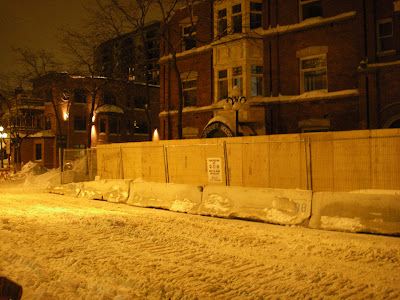
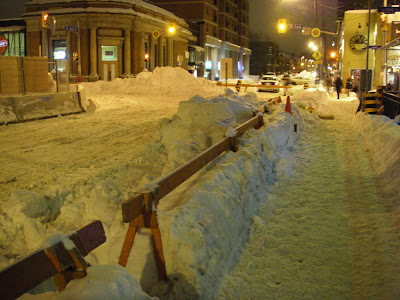
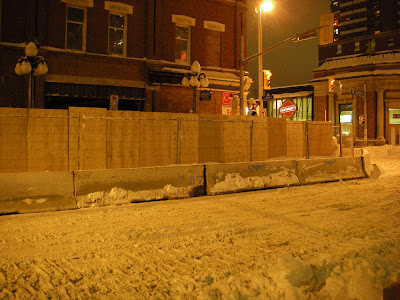
Going home tonight, I stopped by the Somerset House site, and noticed some changes. There were Jersey barriers around the site, and some of the barricades had been removed. Sure enough, at around 11pm, an article appears on the Citizen's website announcing this intersection will re-open.

Here are my photos from my visit tonight (I also have many photos from previous visits that I have not blogged):


- RG>

Wednesday, November 28, 2007

Climate: a much higher priority than it should be

I just received yet another of those myriad e-mails from friends, acquaintances, and, presumably, random people who coughed while typing and somehow entered my e-mail address.

It's one of those e-mails that invites you to get involved with this campaign, or go to that event, or to otherwise bitch about somebody's inaction climate change. Heck, this week's Charlatan even has a full-page article on how you can save the world if you stop using plastic bags.

Fancy that, eh? And you didn't even have to go out and buy that Prius!

Nobody's really asked me whether or not I believe in climate change, but that hasn't stopped me from telling them that I don't care.

For me, environmentalism is mainly a byproduct of pragmatism. That is to say, any choice I could make for the benefit of the environment is likely to have other benefits that affect me in much more direct and concrete ways.

Consider my decision to use the bicycle as my primary mode of transportation. What are the benefits of riding a bicycle?

Well, for one, I'm not contributing to the smog problem. That means that it is slightly easier to breathe in my neighbourhood and city. That's an environmental benefit. But considering I live on a major street in downtown Ottawa, the difference is negligible.

My community benefits on a financial basis as well: a bicycle is much smaller and lighter than a motor vehicle (including a bus). Having a smaller vehicle means I contribute less to traffic congestion (a benefit you don't get with low- or zero-emission cars), and having a lighter vehicle means the roads I travel on will take longer to deteriorate. These mean it will be longer before the municipality has to spend hundreds of millions of dollars to rebuild the roads I use, and when they do, there will be less need for additional lanes.

But all that means is that property taxes in my city might be very very slightly lower in a decade or two.

A bicycle can't travel as fast as a motor vehicle, and therefore my trips either must take more time, be less frequent, or go less far. Some might see this as a drawback, but it also acts as a benefit, as it requires me to plan my trips better, and consider what I choose as destinations. As proof to that, I rarely go more than 2 kilometres from my home. When you consider that the average person travels four times as far in a day today than they did sixty years ago, and there are many more people, a heckuva lot of roads need to be built to accommodate that traffic. That's extremely expensive for taxpayers.


So by making this choice to cycle, I may have reduced everyone's tax bill by a couple pennies over a decade, not counting inflation. Don't bother giving me an award just for that.

But let's get to the person who really matters in today's society: me.

By cycling, I am getting cardiovascular exercise, thereby improving my health and increasing my life expectancy. If my trips were longer than my average 15-minutes-in-traffic rides, my body would release more serotonin and I'd feel happier, too.

A cynic would say, "If you care so much about your health, why do you eat so much unhealthy food? And why don't you get a doctor to check out that twitch in your eye?" Okay, the twitch thing I should get checked out, but our cynic is correct on the other point. Being healthy and active simply is not a high priority for me, nor is it for the average North American.

While some people put time out of their day to go to the gym or to jog, I cycle precisely to avoid this. Since I need to get to work anyway, why don't I get my exercise while going to work? That's all there is. It saves me time, and saves me having to worry whether I should dedicate a specific time to exercise to improve my health.

Cycling saves me money, too. If I could own and use a car for as little as it costs to go by bike, I would certainly consider it. But even the bus is more expensive: in 2006, my total transportation costs for all modes totaled $706--less than twelve monthly adult bus passes.

While society tends to push money as the most important goal, for me it's time. I don't believe in an afterlife, and I might die in sixty years or in sixty hours--so I'd better make good use of the time I know I have--right now.

There's a wonderful quote by Ivan Illich reprinted in the book "Divorce Your Car!" by Katie Alvord (and probably on my blog once or twice):

The typical American male devotes more than 1,600 hours a year to his car. He sits in it while it goes and while it is idling. He parks it and searches for it. He earns the money to put down on it and to meet the monthly installments. He works to pay for fuel, tolls, insurance, taxes, and traffic tickets. He spends four out of his 16 waking hours on the road or gathering his resources for it. And this figure does not take into account the time consumed by other activities dictated by transport: time spent in hospitals, traffic courts, and garages; time spent watching automobile commercials or attending consumer education meetings to improve the quality of the next buy. The model American puts in 1,600 hours to get 7.500 miles; less than five miles per hour. (Ivan Illich, Energy and Equity, 30-31.)


That bolded part is the most important to me (as much as I get a kick out of the five-miles-per-hour bit): There are some people who actually spend hours each day commuting to and from their boring jobs. To me, this is insane. Commuting is most often a means, not an end.

A means? To what?

To work, which itself is often just a means to get money (which is an end goal only for the most pathological of people). There have been many attempts to make commuting less stressful and more productive (for example, the car radio), but at the end of the day, if you're not deriving pleasure from traveling from one place to another, and if you do a lot of that, then you should think about how your life is structured.

If you live your life in such a way that you don't have to spend so much of it getting from one place to another, you'll have more time, more money (or less need to spend time earning money), and you may have helped keep the mean global temperature from increasing by one degree over the next fifty years.

Gotcha!

Remember, this blog post is about Global Warming; cycling is just an illustration. Compared to my arguments based on pure hedonism, greed, and utility, the altruistic "prevent climate change" argument is pretty weak.

And that's just for the argument to get one person to ride a bicycle. Individuals making changes in their own lives will never solve more than a fraction of the world's problems. There are also many institutional, industrial, and international problems that require change. The changes necessary to address these problems might also affect climate change, but somehow I doubt that a person in a war-torn Middle-Eastern country would really care to sign your petition to prevent Global Warming by reducing bombing in their country to 5% below 1990 levels.

Whenever I hear someone citing "Climate Change", or "Greenhouse Gases", or "Kyoto Protocol", I get the same feeling in my gut as when I hear "Mandatory minimum sentences", "War on Drugs", or "Tough on Crime". It shows that they haven't got their priorities straight.

Like any other buzzword, these terms are used by people to draw attention to themselves, to their groups, or to the events they are organizing. Were these people to actually look at the goals of these events, how to achieve them, and how to sell them, they might actually elicit some real change.

- RG>