I'm not as hellbent against Ottawa's proposed transit tunnel as Ken Gray is, though many details and options were glossed over in the decision to go with the current transit strategy. This is a slight improvement over the previous plan, which was entirely mired in secrecy, to the point that Councillors had to sign a non-disclosure agreement just to see the contract they were approving.
Citizen blogger David Reevely has been reading the City's Interim geotechnical report (which I haven't read). Apparently, as reported in an article posted to the Citizen's website this afternoon, they want to shorted the length of the tunnel by almost one-third from the current 3.2 km.
That would bring it to about 2.5km. Which is what was originally proposed in 2008 for the tunnel. At some point since then, the length of the proposed tunnel was extended 0.7km to bring the end of the tunnel closer to Lees station. At the time, it was cited that this would make it logistically easier to extract the TBM, and would be less disruptive than if the tunnel had to make a steep climb up near Laurier. City staff said the cost difference wouldn't be significant.
Now we're hearing the reverse.
We've been told time and time again that the price tag on the rail project is a "very conservative estimate" that will come down as details are worked out, and that the project includes a $100M contingency to cover unexpected increases in cost. This was the party line repeated time and time again by then-Mayor Larry O'Brien and then-Transit Committee Chair Alex Cullen--neither of whom were re-elected.
Now we're hearing that the geotechnical parameters of the tunnel exceed those of the "very conservative estimate."
While it might be tempting to think this apparently new recommendation came about because we have more information, how new can that information be if the original proposal suggested the same thing?
- RG>
Showing posts with label transit. Show all posts
Showing posts with label transit. Show all posts
Tuesday, December 21, 2010


Thursday, April 22, 2010
Thank you for this.
Yesterday at Transportation Committee, City Staff presented councillors with an offer from New Flyer for some discount buses. The councillors who were let in on the deal before the meeting were told not to talk about it.
The report itself wasn't available in advance of the meeting, and isn't on the agenda for the meeting (unless it's the blandly titled item 4, "FLEET ACQUISITION STRATEGY", which doesn't link to any report). Additionally, the Committee had to waive the rules of procedure in order not only to hear the report without advance notice (to councillors or to the public), but also to discuss and decide on it.
The Committee approved the recommendation, thus sending it to Council to consider (not sure exactly when, but I suspect May 12). If any member of the public wanted to scrutinize the details, they had between the time the report was presented and presumably a few minutes after that to review the information and make a presentation.
The details of the offer are now available--after the Committee made its decision--but none of the articles I've seen so far have been able to explain the secrecy.
I e-mailed Transit Committee Alex Cullen asking for the report, and asking about this secrecy, since he chairs the committee and new about the deal before the meeting, and also because he's very big on transparency and fairness in government.
His reply:
The report wasn't on the Committee Agendas & Minutes page, though Ken Gray posted something official resembling the report on his blog in the intervening time of the messages. Since the meeting wasn't broadcast or webcast, the public will have to wait for the minutes to be posted to hear how the committee members scrutinized the deal they were just told about.
When I replied to Councillor Cullen reiterating my question about the need for urgency, he replied:
It's tough because I'm usually on the same side as Alex (I've even held back a few punches in this post), but on this one there are simply too many loose ends that are being swept under the rug.
- RG>
The report itself wasn't available in advance of the meeting, and isn't on the agenda for the meeting (unless it's the blandly titled item 4, "FLEET ACQUISITION STRATEGY", which doesn't link to any report). Additionally, the Committee had to waive the rules of procedure in order not only to hear the report without advance notice (to councillors or to the public), but also to discuss and decide on it.
The Committee approved the recommendation, thus sending it to Council to consider (not sure exactly when, but I suspect May 12). If any member of the public wanted to scrutinize the details, they had between the time the report was presented and presumably a few minutes after that to review the information and make a presentation.
The details of the offer are now available--after the Committee made its decision--but none of the articles I've seen so far have been able to explain the secrecy.
I e-mailed Transit Committee Alex Cullen asking for the report, and asking about this secrecy, since he chairs the committee and new about the deal before the meeting, and also because he's very big on transparency and fairness in government.
His reply:
Thank you for this. First, I am not Chair of Transportation Committee, but Chair of Transit Committee*. Second, you should be able to find this report on the City's web site under Council & Committee Agendas & Minutes. Third, this is not a sole-source contract but is well within the existing contract that the City has with New Flyer Industries. What has happened is that New Flyer had a large order from Chicago cancelled (they are going through some tough economic times there) and came to us with an offer to accelerate our bus replacement program at a far cheaper price, with the additional benefits of better warranties (5 years instead of the industry 2-year norm) plus lower maintenance costs and higher fuel efficiencies. It is a very good deal and very affordable.Hopefully you didn't read it all looking for the reason why it had to be kept under wraps until the meeting and why it had to be considered so urgently, because there's nothing of the sort in his reply. Just stuff about how it's such a good deal, which placates some and not others.
It is unfortunate that, due to timing issues (the final proposal from New Flyer came last Friday, and staff have been working hard to analyze it and provide due diligence) this report could not be made public beforehand, but it is too good a deal to ignore. Transit Committee did spend quite a bit of time on this matter and did endorse this proposal for Council's consideration.
[*RG: this was my bad, two of four references in my original e-mail were to Transportation Committee, which I'm more used to dealing with]
The report wasn't on the Committee Agendas & Minutes page, though Ken Gray posted something official resembling the report on his blog in the intervening time of the messages. Since the meeting wasn't broadcast or webcast, the public will have to wait for the minutes to be posted to hear how the committee members scrutinized the deal they were just told about.
When I replied to Councillor Cullen reiterating my question about the need for urgency, he replied:
Thank you for this. New Flyer had a time-limited window to make this offer, as they had to cover the cancelled order or lay people off - another reason for the good price.I'm sure Alex is a busy guy with lots of stuff to do--running for mayor, being one, so he probably didn't have time to answer this question, and the question of why everyone was sworn to secrecy beforehand (reminiscent of the horrible N-S LRT project killed in 2006 whose secret contract ended up costing us $37 million for nothing), but I'm surprised that most of the mainstream coverage completely skips over this issue now that it's passed. Makes it really frustrating for those of us who weren't in the room to figure out why our elected representatives did this.
It's tough because I'm usually on the same side as Alex (I've even held back a few punches in this post), but on this one there are simply too many loose ends that are being swept under the rug.
- RG>
Wednesday, March 03, 2010
OCome on, Transpo
The Citizen's Hugh Adami has yet another column about a ridiculous case of zero-tolerance OC Transpo fare rules. The page doesn't have a comment section, so I'm posting my comments here.
In this case, Sean Nagasar, an Algonquin College student with dyslexia and another condition that makes it very difficult to write, didn't have the numbers filled in on his transit pass, which he bought on Saturday. He did not have an opportunity to get a friend to fill it out for him before Monday morning (March 1st), when he first used it.
You have to fill in the numbers on your pass with the numbers on your photo ID card because the passes are non-transferable. The article says it's been required to fill in the numbers since 2007, but I stopped riding the bus a couple years before that and I ran into a similar situation with the fare inspectors.
Actually, in my years-old case, it was the second of the month and I didn't have my new pass yet (not like any of the four drivers who saw my pass on the first of the month were bothered to mention it). Seeing the two previous months' passes stuffed in my holder, the fare inspector let me off with a warning. I think he even got the driver to give me a daypass so I could get to school and then to a place to buy a pass.
And you know why he let me off? Because these rules are designed to stop people from cheating the system, not to require them to pass stupid little trials. The fare inspector in my case had the common sense to realize that, in the middle of the school year, since I had the previous two months' passes, chances are I would be buying the current month's pass. Maybe in 2007 OC Transpo management revoked fare inspectors' ability to use common sense.
If Nagasar fights his ticket in court, the fare inspector could easily testify that the student had not filled in the numbers on his pass. But he'd have a hell of a hard time arguing that he suspected Nagasar was trying to cheat the system--the problem this technical rule aims to solve. For fuck's sake, he doesn't even have the dexterity to write, much less swap out bus passes with his buddies.
Alex Cullen, Chair of the City's Transit Committee, tells the Citizen, "...supporting our fare inspectors doing their job will make me look as insensitive as you have portrayed them, and taking the side of the student undermines their work on behalf of taxpayers. It’s a lose-lose situation."
Well, Cullen's lost it indeed. Fare inspectors' "work on behalf of taxpayers" is to catch people who abuse the fare system, not to waste their salaries ticketing disabled students (and testifying against them in court) for not being able to write.
- RG>
In this case, Sean Nagasar, an Algonquin College student with dyslexia and another condition that makes it very difficult to write, didn't have the numbers filled in on his transit pass, which he bought on Saturday. He did not have an opportunity to get a friend to fill it out for him before Monday morning (March 1st), when he first used it.
You have to fill in the numbers on your pass with the numbers on your photo ID card because the passes are non-transferable. The article says it's been required to fill in the numbers since 2007, but I stopped riding the bus a couple years before that and I ran into a similar situation with the fare inspectors.
Actually, in my years-old case, it was the second of the month and I didn't have my new pass yet (not like any of the four drivers who saw my pass on the first of the month were bothered to mention it). Seeing the two previous months' passes stuffed in my holder, the fare inspector let me off with a warning. I think he even got the driver to give me a daypass so I could get to school and then to a place to buy a pass.
And you know why he let me off? Because these rules are designed to stop people from cheating the system, not to require them to pass stupid little trials. The fare inspector in my case had the common sense to realize that, in the middle of the school year, since I had the previous two months' passes, chances are I would be buying the current month's pass. Maybe in 2007 OC Transpo management revoked fare inspectors' ability to use common sense.
If Nagasar fights his ticket in court, the fare inspector could easily testify that the student had not filled in the numbers on his pass. But he'd have a hell of a hard time arguing that he suspected Nagasar was trying to cheat the system--the problem this technical rule aims to solve. For fuck's sake, he doesn't even have the dexterity to write, much less swap out bus passes with his buddies.
Alex Cullen, Chair of the City's Transit Committee, tells the Citizen, "...supporting our fare inspectors doing their job will make me look as insensitive as you have portrayed them, and taking the side of the student undermines their work on behalf of taxpayers. It’s a lose-lose situation."
Well, Cullen's lost it indeed. Fare inspectors' "work on behalf of taxpayers" is to catch people who abuse the fare system, not to waste their salaries ticketing disabled students (and testifying against them in court) for not being able to write.
- RG>
Wednesday, December 30, 2009
A lesson on bus selection for OC Transpo
I'm a bit of a transit geek, and while I'm nowhere near as hardcore as some people, I do know that OC Transpo has made some questionable decisions on bus selection. The old Ikarus articulated buses, for example, had to be cannibalized to maintain them, then couldn't even be given away once decommissioned (AFAIK they may still be sitting in a field somewhere). Then there's the buses they bought in the '90s, whose windows only opened at the top because the buses came with air conditioning, but the A/C had been irreversibly removed as a cost saving measure early in their lifetime, resulting in some very uncomfortable buses.
More recently, OC Transpo bought 365 of the hump-backed buses in the 4200 series starting in 2004, and is one of very few transit services to have bought the now-discontinued model, meaning parts will likely be in short supply when it comes time for their overhaul nine years after purchase. The three double-decker buses it recently purchased (with the possibility of buying more) require a whole new garage to be built to service them, because three axles fit in the 40-foot frame instead of the usual two, and thus three lifts are needed--not to mention an extra-tall garage door. It was recently reported that OC Transpo does not have a garage that is licensed to certify buses for their safety inspections that has doors tall enough to accommodate the double-deckers. The inspections will have to be outsourced.
Oh, and did you know that the articulated buses in OC Transpo's fleet have four-cylinder engines, instead of the more popular six-cylinder option? That'll also hurt your resale value (as will the windshields popping out only a couple of years into service).
All this leads me to believe that OC Transpo doesn't properly test buses before selecting them.
The following BBC video shows some thorough testing of different styles of buses available in the UK. The test takes into account passenger comfort, accessibility, and speed of service. The test was also conducted on a closed circuit, to avoid casualties to cyclists and pedestrians.
OC Transpo, I hope you're paying attention.
- RG>
More recently, OC Transpo bought 365 of the hump-backed buses in the 4200 series starting in 2004, and is one of very few transit services to have bought the now-discontinued model, meaning parts will likely be in short supply when it comes time for their overhaul nine years after purchase. The three double-decker buses it recently purchased (with the possibility of buying more) require a whole new garage to be built to service them, because three axles fit in the 40-foot frame instead of the usual two, and thus three lifts are needed--not to mention an extra-tall garage door. It was recently reported that OC Transpo does not have a garage that is licensed to certify buses for their safety inspections that has doors tall enough to accommodate the double-deckers. The inspections will have to be outsourced.
Oh, and did you know that the articulated buses in OC Transpo's fleet have four-cylinder engines, instead of the more popular six-cylinder option? That'll also hurt your resale value (as will the windshields popping out only a couple of years into service).
All this leads me to believe that OC Transpo doesn't properly test buses before selecting them.
The following BBC video shows some thorough testing of different styles of buses available in the UK. The test takes into account passenger comfort, accessibility, and speed of service. The test was also conducted on a closed circuit, to avoid casualties to cyclists and pedestrians.
OC Transpo, I hope you're paying attention.
- RG>
Monday, August 24, 2009
Ken Gray posts Ottawa's AMO briefing notes
Ottawa Citizen editor Ken Gray has posted on his blog, The Bulldog, a bunch of private briefing notes and related materials that the City of Ottawa brought to the recent Association of Municipalities of Ontario (AMO) conference.
They cover a variety of topics, from transit to housing to policing to rural issues. Most deal with different ways of asking for more money, with varying degrees of believability. I believe this link should link to these briefing notes after these posts have fallen off the front page of the blog.
Some of them are really interesting, and some of them are really dry. For a policy wonk like me, This one is educational. It talks about how the Federal Government's decision to sell many of its properties and lease them back causes the City to take in less money in property taxes. The reason? Even though the Federal Government is exempt from paying property taxes, they pay payments-in-lieu of taxes as a goodwill gesture (since it still costs the City to service these buildings). But the entire amount of this went straight from the Feds to the City, now that it's private companies paying the taxes, a portion is now going to the Province to cover education taxes, resulting in a few million dollars less revenue for the City (and as much as $25 million less if the Feds sell and lease-back lots more of their properties).
So read up, and you'll know as much as Jim Watson does on these issues.
- RG>
They cover a variety of topics, from transit to housing to policing to rural issues. Most deal with different ways of asking for more money, with varying degrees of believability. I believe this link should link to these briefing notes after these posts have fallen off the front page of the blog.
Some of them are really interesting, and some of them are really dry. For a policy wonk like me, This one is educational. It talks about how the Federal Government's decision to sell many of its properties and lease them back causes the City to take in less money in property taxes. The reason? Even though the Federal Government is exempt from paying property taxes, they pay payments-in-lieu of taxes as a goodwill gesture (since it still costs the City to service these buildings). But the entire amount of this went straight from the Feds to the City, now that it's private companies paying the taxes, a portion is now going to the Province to cover education taxes, resulting in a few million dollars less revenue for the City (and as much as $25 million less if the Feds sell and lease-back lots more of their properties).
So read up, and you'll know as much as Jim Watson does on these issues.
- RG>
Friday, June 19, 2009
On-street rail: a century-old non-problem
In reading the background papers for the LRT Technology Forum tomorrow morning, much ado is made about segregated corridors. That is to say, if you don't put rail in a tunnel or up in the air, you need to put up fences to keep pedestrians from crossing the line, or else chaos will result.
So it's interesting that I came upon a video of Vancouver Streetcar traffic in 1907, which clearly shows pedestrians, cyclists and horse-drawn carriages crossing the streetcar tracks with no difficulty or conflict. (Nor, I might add, signals to tell them when and where to cross)
If they put light rail along the Western Parkway (emphasis on "if"), would tracks with a train passing promptly every 30 or 60 seconds really be as dangerous to cross as, say, the four lanes of constant car and bus traffic already there?
Why don't we have fences along, say, Carling?
Yet another bias in our car-based culture. Cars and buses are safe because they're normal, trains are dangerous because we're not used to them.
- RG>
So it's interesting that I came upon a video of Vancouver Streetcar traffic in 1907, which clearly shows pedestrians, cyclists and horse-drawn carriages crossing the streetcar tracks with no difficulty or conflict. (Nor, I might add, signals to tell them when and where to cross)
If they put light rail along the Western Parkway (emphasis on "if"), would tracks with a train passing promptly every 30 or 60 seconds really be as dangerous to cross as, say, the four lanes of constant car and bus traffic already there?
Why don't we have fences along, say, Carling?
Yet another bias in our car-based culture. Cars and buses are safe because they're normal, trains are dangerous because we're not used to them.
- RG>
Friday, May 29, 2009
On Chevrolets and Cadillacs
I was at a meeting this past week where there was one of those interminable discussions on public transit in Ottawa. You know the ones--someone new talks about how easily transit could be improved in Ottawa and all the old hats have to tell them that logical arguments don't work in this city. (You don't know those types of meetings? Consider yourself lucky)
The boredom of this particularly long spell of circular discussions put me into a hypnotic spell in which I had a flashback to a catchphrase from the last LRT project.
Back in the 2003 municipal election, there was much to do about Cadillacs. There was an article in the Citizen on November 3 that is a case in point. You can read it in the Proquest archive here if you have an Ottawa Public Library card and PIN.
The article, "Chiarelli's priorities for Ottawa" by David Reevely, repeats the contemporary meme that the City was spending a lot of money on "Cadillac" projects, the metaphor suggesting that the City should not be using tax dollars to build luxury projects.
The case in point for this analogy was the O-Train expansion, which at the time had not grown into the $900-million North-South Light Rail Transit project that was killed shortly after the following election.
Instead of reaching the east end by 2018, as the 2003 plans suggested, it will now only go as far as Blair in the east and Tunney's Pasture in the west by that time.
On the one hand, the O-Train extension was considered expensive and luxurious--a "Cadillac" plan in comparison to the existing "Chevy" bus service. By that comparison, though, we're now building a Hummer system: something that costs a lot more and doesn't go nearly as far.
It's unfortunate that Bob Chiarelli turned his back on the idea of using existing track to cheaply expand rapid transit. It lost him the 2006 election big time. Now we're planning a Hummer system which probably won't even get built, leaving us with our Chevy bus system.
Now, in 2009, as Chevrolet struggles against bankruptcy, do we really want the City of Ottawa to keep on the Chevy trail?
- RG>
The boredom of this particularly long spell of circular discussions put me into a hypnotic spell in which I had a flashback to a catchphrase from the last LRT project.
Back in the 2003 municipal election, there was much to do about Cadillacs. There was an article in the Citizen on November 3 that is a case in point. You can read it in the Proquest archive here if you have an Ottawa Public Library card and PIN.
The article, "Chiarelli's priorities for Ottawa" by David Reevely, repeats the contemporary meme that the City was spending a lot of money on "Cadillac" projects, the metaphor suggesting that the City should not be using tax dollars to build luxury projects.
The case in point for this analogy was the O-Train expansion, which at the time had not grown into the $900-million North-South Light Rail Transit project that was killed shortly after the following election.
"If you're going to look at getting Chevys instead of Cadillacs, I think you have to take a hard look at the O-Train," said J.-F. Claude, running in Innes ward. "It's not going to reach the east end until 2018, and it's a Cadillac system where we're dealing with a Chevy budget."It's crazy to think that the 2003 Transportation Master Plan (TMP) proposed 120 kilometres of light rail, mostly using existing track to expand rail cheaply and effectively, whereas the 2008 update significantly reduced the amount of rail and opted for a much more expensive version of rail.
The city's transit money would be much better spent on more and better buses, Mr. Claude said.
Mr. Chiarelli, however, argues that it costs about $2 million a kilometre to convert existing track for the O-Train's use, versus $12 million a kilometre to expand the Transitway.
"Light rail is about as efficient as you can get," he said, adding that city staff are already looking at ways to expand the system as cheaply as possible.
Instead of reaching the east end by 2018, as the 2003 plans suggested, it will now only go as far as Blair in the east and Tunney's Pasture in the west by that time.
On the one hand, the O-Train extension was considered expensive and luxurious--a "Cadillac" plan in comparison to the existing "Chevy" bus service. By that comparison, though, we're now building a Hummer system: something that costs a lot more and doesn't go nearly as far.
It's unfortunate that Bob Chiarelli turned his back on the idea of using existing track to cheaply expand rapid transit. It lost him the 2006 election big time. Now we're planning a Hummer system which probably won't even get built, leaving us with our Chevy bus system.
Now, in 2009, as Chevrolet struggles against bankruptcy, do we really want the City of Ottawa to keep on the Chevy trail?
- RG>
Thursday, April 30, 2009
City reveals what we knew all along
So I attended the City's media events on the Downtown Ottawa Transit Tunnel study, where they "revealed" their recommended alignment.
I got there late for the photo op under the Plaza bridge, but I wasn't too concerned because that's mostly politicians giving a glossy version of what Staff would be explaining in much better detail later on back at City Hall.
 Surprise, surprise, Transit Committee Chair Alex Cullen was behind the microphone. Mayor Larry O'Brien is standing aside. I'm sure he gave some awkward platitudes earlier in the session.
 Also on hand were Planning and Environment Committee Chair Peter Hume and Transportation Committee Chair Maria McRae, who kept calling for Councillor Cullen to stop talking so everyone could move on to the next part of the event back at City Hall.
 She almost got her wish, until Councillor Jacques Legendre asked from the scrum why the event was held here. Cullen replied, "right here will be an entrance to one of the stations--the Rideau station."
This inspired members of the media to ask other questions. One interesting response from Councillor Cullen was that the tunnel is coming in "under budget", at $600 million, far less than the $1 billion projected. By former Regional Reeve Andrew Haydon. In the 1980's. This is selective memory on Cullen's part. Consider that the City's 2003 Transportation Master Plan called for 120 kilometres of light rail on existing track, and the first two phases, going from Orleans to Kanata to Riverside South, would cost about $3 billion total.
Anyway, the session resumed at 1:45 in the Colonel By room, where Vivi Chi went through the slideshow (pdf) on the recommended alignment.
 I was really quite surprised. Not at what it recommended, but that they bothered announcing it. Aside from an extra 700 metres of tunnel from Laurier to Mann, this is exactly what City Staff have been saying is their preference all along. It makes you wonder why we even bothered to go through public consultation.
This "public consultation" process reminds me of my high school essays. To prove we had spent time on it, we had to submit rough drafts of our essays. Frequently, we would simply write our essays the night before, then introduce spelling errors into alternate versions, which we submitted as "rough drafts." It was clear from the previous public consultation that City Staff wanted the cross-country alignment, that they wanted the centre platform station design, and that they wanted to have the O-Train line merge with the East-West line.
I have to admit, I was a bit surprised that they decided against building temporary bus infrastructure for LeBreton station, but I'm not the least bit surprised that they found no way to keep Transitway buses from using Scott and Albert to get between Westboro/Tunneys and Bayview/LeBreton once Phase I is finished and Phase II isn't yet started.
When I asked Vivi Chi about this after the briefing, she said that they need to look at ways of mitigating it, and there's lots of work to be done. Translated to English: Scott/Albert is convenient for them, so they're not going to seriously consider alternatives to save the neighbourhoods along these roads from having a surface Transitway on their doorstep for the next ten or more years.
It was also a surprise that the tunnel would be extended by about a third beyond the previously-suggested East entrance at Campus station to just south of Mann Avenue. Apparently, this would minimize disruption at Laurier and Waller when the East end of the tunnel is built, which I'm skeptical is worth the price of 700 metres of cut-and-cover tunnel. It certainly would require more consultant time to design!
Councillors raised some interesting points (disguised as questions). Rideau-Vanier Councillor Georges Bédard mentioned the Rideau Centre's concern that the tunnel station will be immediately below Rideau Street. They prefer the regional transit to be on one end of the Rideau Centre and the local transit to be on the other (i.e. the Transitway is currently on the Mackenzie-King Bridge and local buses are on Rideau), so that people are forced to walk through the Rideau Centre to transfer, and shop along the way. Bédard noted that the Rideau Centre's sales dropped by 30% during the bus strike.
Since it's clear the tunnel station will be on Rideau, Bédard wants to cripple transit transfers by forcing local buses to go down to Mackenzie-King Bridge, purely so that people will be forced to walk through the Rideau Centre.
Kanata North Councillor Marianne Wilkinson was angry that Staff had done an about-face on bus traffic coming in from the West. She recalls (as did I and the person sitting next to me) that in the last round of discussions, Council was told that express buses coming in from the West would be able to continue to go through downtown until the train line is extended to Baseline, since transferring at Tunney's or LeBreton would make for a very short train ride. Vivi Chi denied that Staff had ever said this, and Councillor Cullen used his Jedi skills to deny it as well. I remember that they had said this, because I have railed (pun unintended) against this terrible decision at every occasion I've had.
I'm a bit torn: I don't like the revisionism on Staff's part, but I also don't like the idea of express buses continuing to go downtown until after 2017, after whenever the next phase is finished. Whatever the case, Council needs to make a concrete decision so that Staff and Councillors are both aware of whether express buses will turn around or continue to downtown.
Rideau-Rockcliffe Councillor Jacques Legendre raised the insightful point about working with downtown landowners:
During the presentation, Chi said, "we still have residual comments on Surface vs. Tunnel, but we've been through that discussion and that debate at Council has been very firm." I had submitted a number of comments that the surface option had not been considered at any point in the process. They did not have the debate at council, and the rationale to discount surface rail in the Transportation Master Plan was restricted to an 81-word paragraph buried in one of the consultant reports. But setting my tunnel grudge aside, Chi said in her presentation that the tunnel would allow the City to "return the surface to the public."
When I asked her how many lanes of Albert and Slater are going to be converted to public parks, she said something about sidewalks and public art in Philadelphia. So in this case, "returning the surface to the public" means returning it to cars. I hope I'm proved wrong on this.
Oh, and did you know that the City will be converting the O-Train line to electric Light Rail? Yeah, that project that was cancelled in 2006 is getting built anyway. Double-tracking the O-Train line, converting to electric. No? Didn't hear about that? Well that's because it's not part of the DOTT study. It is part of the Transportation Master Plan.
Because of lower demand, they'll be running two-car trains along the North-South route, compared with six-car trains on the East-West line. Staff are recommending that these North-South trains be able to turn at Bayview so they can continue downtown.
The problem, as Transport 2000's David Jeanes pointed out on previous occasions, is that with only a handful of stations downtown, and with only one train being able to be at a station at any given time, running a two-car train through downtown to continue down South from Bayview means that you can't run a six-car train through downtown to continue West to Tunney's, and once it is built, Baseline. Capacity is lost.
One way to alleviate this problem is with more stations downtown. Instead of few six-car trains, have more frequent four-car trains, stopping at more stations. This also reduces pedestrian congestion as six train cars' worth of passengers all try to leave the station at once.
From centre-of-platform to centre-of-platform, the proposed stations are 650 metres apart, compared with 400-500 metres between urban core stations in Toronto, Vancouver, Edmonton and Montreal (according to Jeanes). Staff respond that Ottawa's stations will be 180 meres long, with entrances on both ends, so it's effectively like having twice as many. But newer stations in other cities have entrances on both ends, and Ottawa's trains won't have six cars for some time to come. Furthermore, they'll be 30 metres below the surface. Combined, this means a lot more walking to add to your commute time.
Staff also respond that the stations cost a lot of money--as much as $150 million. Jeanes has explained that it costs this much (as opposed to Toronto's Sheperd station, which cost a third that amount) because Staff are recommending stations with huge, cavernous interiors like those in Washington, D.C.
Connecting this all back with Bayview, the problem with Bayview's merging alignment is that rush-hour trains coming from the South won't be able to go to and through downtown, because there won't be capacity for them.
The problem with City Staff, meanwhile, is that they keep dismissing these problems, saying "those are operating questions that we have not gotten into. Right now we're looking at facilities."
I got a more straightforward version from the consultant Hopper:
If you're going to require people coming from the south to transfer at Bayview anyway, it begs the question: why bother electrifying and converting the O-Train at all? Why build the more expensive and complex station at Bayview with the tracks merging? And why don't you just leave it the way it is and extend it across the Prince of Wales rail bridge to Gatineau?
The best answer to many of these questions (à la Occam's Razor) is, as Friend of the O-Train Tim Lane likes to sarcastically say, "it's not expensive enough."
- RG>
I got there late for the photo op under the Plaza bridge, but I wasn't too concerned because that's mostly politicians giving a glossy version of what Staff would be explaining in much better detail later on back at City Hall.
 Surprise, surprise, Transit Committee Chair Alex Cullen was behind the microphone. Mayor Larry O'Brien is standing aside. I'm sure he gave some awkward platitudes earlier in the session.
 Also on hand were Planning and Environment Committee Chair Peter Hume and Transportation Committee Chair Maria McRae, who kept calling for Councillor Cullen to stop talking so everyone could move on to the next part of the event back at City Hall.
 She almost got her wish, until Councillor Jacques Legendre asked from the scrum why the event was held here. Cullen replied, "right here will be an entrance to one of the stations--the Rideau station."
This inspired members of the media to ask other questions. One interesting response from Councillor Cullen was that the tunnel is coming in "under budget", at $600 million, far less than the $1 billion projected. By former Regional Reeve Andrew Haydon. In the 1980's. This is selective memory on Cullen's part. Consider that the City's 2003 Transportation Master Plan called for 120 kilometres of light rail on existing track, and the first two phases, going from Orleans to Kanata to Riverside South, would cost about $3 billion total.
Anyway, the session resumed at 1:45 in the Colonel By room, where Vivi Chi went through the slideshow (pdf) on the recommended alignment.
 I was really quite surprised. Not at what it recommended, but that they bothered announcing it. Aside from an extra 700 metres of tunnel from Laurier to Mann, this is exactly what City Staff have been saying is their preference all along. It makes you wonder why we even bothered to go through public consultation.
This "public consultation" process reminds me of my high school essays. To prove we had spent time on it, we had to submit rough drafts of our essays. Frequently, we would simply write our essays the night before, then introduce spelling errors into alternate versions, which we submitted as "rough drafts." It was clear from the previous public consultation that City Staff wanted the cross-country alignment, that they wanted the centre platform station design, and that they wanted to have the O-Train line merge with the East-West line.
I have to admit, I was a bit surprised that they decided against building temporary bus infrastructure for LeBreton station, but I'm not the least bit surprised that they found no way to keep Transitway buses from using Scott and Albert to get between Westboro/Tunneys and Bayview/LeBreton once Phase I is finished and Phase II isn't yet started.
When I asked Vivi Chi about this after the briefing, she said that they need to look at ways of mitigating it, and there's lots of work to be done. Translated to English: Scott/Albert is convenient for them, so they're not going to seriously consider alternatives to save the neighbourhoods along these roads from having a surface Transitway on their doorstep for the next ten or more years.
It was also a surprise that the tunnel would be extended by about a third beyond the previously-suggested East entrance at Campus station to just south of Mann Avenue. Apparently, this would minimize disruption at Laurier and Waller when the East end of the tunnel is built, which I'm skeptical is worth the price of 700 metres of cut-and-cover tunnel. It certainly would require more consultant time to design!
Councillors raised some interesting points (disguised as questions). Rideau-Vanier Councillor Georges Bédard mentioned the Rideau Centre's concern that the tunnel station will be immediately below Rideau Street. They prefer the regional transit to be on one end of the Rideau Centre and the local transit to be on the other (i.e. the Transitway is currently on the Mackenzie-King Bridge and local buses are on Rideau), so that people are forced to walk through the Rideau Centre to transfer, and shop along the way. Bédard noted that the Rideau Centre's sales dropped by 30% during the bus strike.
Since it's clear the tunnel station will be on Rideau, Bédard wants to cripple transit transfers by forcing local buses to go down to Mackenzie-King Bridge, purely so that people will be forced to walk through the Rideau Centre.
Kanata North Councillor Marianne Wilkinson was angry that Staff had done an about-face on bus traffic coming in from the West. She recalls (as did I and the person sitting next to me) that in the last round of discussions, Council was told that express buses coming in from the West would be able to continue to go through downtown until the train line is extended to Baseline, since transferring at Tunney's or LeBreton would make for a very short train ride. Vivi Chi denied that Staff had ever said this, and Councillor Cullen used his Jedi skills to deny it as well. I remember that they had said this, because I have railed (pun unintended) against this terrible decision at every occasion I've had.
I'm a bit torn: I don't like the revisionism on Staff's part, but I also don't like the idea of express buses continuing to go downtown until after 2017, after whenever the next phase is finished. Whatever the case, Council needs to make a concrete decision so that Staff and Councillors are both aware of whether express buses will turn around or continue to downtown.
Rideau-Rockcliffe Councillor Jacques Legendre raised the insightful point about working with downtown landowners:
"A few years ago, when we were talking about the Chiarelli system... [Downtown business owners] were a bit taken aback [when asked to come to the table], and came back and said 'we're ready to come to the table.' We never talked to them. Let's not repeat that error. Please."After the event broke up, I spoke with Vivi Chi about some lingering questions.
During the presentation, Chi said, "we still have residual comments on Surface vs. Tunnel, but we've been through that discussion and that debate at Council has been very firm." I had submitted a number of comments that the surface option had not been considered at any point in the process. They did not have the debate at council, and the rationale to discount surface rail in the Transportation Master Plan was restricted to an 81-word paragraph buried in one of the consultant reports. But setting my tunnel grudge aside, Chi said in her presentation that the tunnel would allow the City to "return the surface to the public."
When I asked her how many lanes of Albert and Slater are going to be converted to public parks, she said something about sidewalks and public art in Philadelphia. So in this case, "returning the surface to the public" means returning it to cars. I hope I'm proved wrong on this.
Oh, and did you know that the City will be converting the O-Train line to electric Light Rail? Yeah, that project that was cancelled in 2006 is getting built anyway. Double-tracking the O-Train line, converting to electric. No? Didn't hear about that? Well that's because it's not part of the DOTT study. It is part of the Transportation Master Plan.
Because of lower demand, they'll be running two-car trains along the North-South route, compared with six-car trains on the East-West line. Staff are recommending that these North-South trains be able to turn at Bayview so they can continue downtown.
The problem, as Transport 2000's David Jeanes pointed out on previous occasions, is that with only a handful of stations downtown, and with only one train being able to be at a station at any given time, running a two-car train through downtown to continue down South from Bayview means that you can't run a six-car train through downtown to continue West to Tunney's, and once it is built, Baseline. Capacity is lost.
One way to alleviate this problem is with more stations downtown. Instead of few six-car trains, have more frequent four-car trains, stopping at more stations. This also reduces pedestrian congestion as six train cars' worth of passengers all try to leave the station at once.
From centre-of-platform to centre-of-platform, the proposed stations are 650 metres apart, compared with 400-500 metres between urban core stations in Toronto, Vancouver, Edmonton and Montreal (according to Jeanes). Staff respond that Ottawa's stations will be 180 meres long, with entrances on both ends, so it's effectively like having twice as many. But newer stations in other cities have entrances on both ends, and Ottawa's trains won't have six cars for some time to come. Furthermore, they'll be 30 metres below the surface. Combined, this means a lot more walking to add to your commute time.
Staff also respond that the stations cost a lot of money--as much as $150 million. Jeanes has explained that it costs this much (as opposed to Toronto's Sheperd station, which cost a third that amount) because Staff are recommending stations with huge, cavernous interiors like those in Washington, D.C.
Connecting this all back with Bayview, the problem with Bayview's merging alignment is that rush-hour trains coming from the South won't be able to go to and through downtown, because there won't be capacity for them.
The problem with City Staff, meanwhile, is that they keep dismissing these problems, saying "those are operating questions that we have not gotten into. Right now we're looking at facilities."
I got a more straightforward version from the consultant Hopper:
"Well, that's an operational decision; there may be times when you're running six-car trains East-West in the crush of rush hour where you don't want to slip in a two-car train from North-South, and other times you may, so operationally you'd have the option to turn the train or run it all the way through."Essentially, what he's saying is that under Staff's recommended solution, people coming in from Riverside South (and potentially Barrhaven, if Light Rail is extended that far in the future) will likely have to transfer from their two-car train on Bayview's lower platform to the six-car train on the upper platform. This is exactly what Councillor Wilkinson was incensed about for her express bus users until Phase II is built, except that this would be a permanent situation for Riverside South.
If you're going to require people coming from the south to transfer at Bayview anyway, it begs the question: why bother electrifying and converting the O-Train at all? Why build the more expensive and complex station at Bayview with the tracks merging? And why don't you just leave it the way it is and extend it across the Prince of Wales rail bridge to Gatineau?
The best answer to many of these questions (à la Occam's Razor) is, as Friend of the O-Train Tim Lane likes to sarcastically say, "it's not expensive enough."
- RG>
Friday, April 17, 2009
Proof that god doesn't exist
Posted by vitamin_oc on the OC Transpo Livejournal page:
 I also like last month's editorial cartoon in the Centretown News, which depicts a bus ad reading "Think", to which an onlooker remarks "How offensive!"
- RG>
 I also like last month's editorial cartoon in the Centretown News, which depicts a bus ad reading "Think", to which an onlooker remarks "How offensive!"
- RG>
Tuesday, March 10, 2009
Sent to City Council this morning...
10 March 2009
Dear members of Council,
There are far better things for Council to do than spending hours (or even minutes) discussing whether OC Transpo should accept advertising money from Atheists. There are better things for me to do than writing you about it, but the matter is on the agenda for tomorrow's City Council meeting and I feel compelled to do so.
The preamble to Councillor Cullen's motion makes a very solid case for doing so on freedom of speech grounds. In addition, OC Tranpo can use all the revenue it can get at this point.
To deny the ads because some people "might" be offended is, frankly, offensive to non-believers and to those who support freedom of speech. Ottawa is not a nanny state.
Neither OC Transpo nor City Council has done anything about the "Lock up your daughters" campaign, which DOES offend many people. And instead of calling for these ads to be banned, those offended by this campaign have pressured the radio station into removing their ads, without having to resort to censorship from the municipal government.
Please carry the Cullen motion and move on to important issues.
- RG>
Dear members of Council,
There are far better things for Council to do than spending hours (or even minutes) discussing whether OC Transpo should accept advertising money from Atheists. There are better things for me to do than writing you about it, but the matter is on the agenda for tomorrow's City Council meeting and I feel compelled to do so.
The preamble to Councillor Cullen's motion makes a very solid case for doing so on freedom of speech grounds. In addition, OC Tranpo can use all the revenue it can get at this point.
To deny the ads because some people "might" be offended is, frankly, offensive to non-believers and to those who support freedom of speech. Ottawa is not a nanny state.
Neither OC Transpo nor City Council has done anything about the "Lock up your daughters" campaign, which DOES offend many people. And instead of calling for these ads to be banned, those offended by this campaign have pressured the radio station into removing their ads, without having to resort to censorship from the municipal government.
Please carry the Cullen motion and move on to important issues.
- RG>
Friday, February 13, 2009
Deamalgamation, or politics as usual?
According to the Citizen, Capital ward Councillor Clive Doucet is calling for de-amalgamation. According to the article, this is "the first time an elected leader from inside the Greenbelt has publicly voiced such an opinion." Which I find odd, because I've shared this view with Doucet on many occasions.
As someone who lives and works in Centretown, I've always had difficulty trying to understand what I would have in common with someone from North Gower, Fitzroy Harbour, Manotick, Greely, Carp, Kars, Vars, or Mars. (Sorry, that last one isn't on the list.)
In his blog post titled A council that can't make up its mind, ostensibly on the transit strike, Citizen editor David Reevely writes: (my emphasis)
But Reevely--like Doucet--is right.
At the recent public meeting on SCAN, the point was raised that you can't just create legislation to evict addicts (for example) without first addressing the root problems that cause the addiction. You evict addicts from one place, and they move to another one. Or they turn to a life of crime. Either way, it's going to be society's problem. But when the debate is framed in terms of eviction, this underlying problem never goes away.
Similarly, you can't really have a discussion on transit issues in this City, period. City Council has demonstrated this many times in recent memory. And I'm not just lamenting the cancellation of the North-South Light Rail Transit (N-S LRT) project, as Doucet often does. In fact, I don't lament its cancellation at all. The chaos led that project so far down the wrong track is the same chaos that is behind the governance void we see today. And that was with a Mayor who knew what he was doing.
But maybe some good will come from this Pyrrhic bus strike. The anger, tension, and polarization it has caused among councillors may be the catalyst that is needed to overhaul our municipal governance structure.
Now, I'm not sure if returning to Ottawa's pre-amalgamation structure would be a good idea, or even possible--a lot has changed since then. On the other hand, the borough system that Glen Brooks suggests in the article (albeit only for his ward!), which sounds like the proposal by Alex Munter in the 2006 election campaign, may not do enough to fix the problems that we are currently facing.
In the above-linked blog post, David Reevely makes another suggestion:
Frankly, the thing that's wrong in this city is that "solutions" spill out from all directions before the problem is ever adequately defined. We have to properly describe where amalgamation has gone wrong, and agree on that definition, before we look for solutions that address those problems. And it has to be done together, not yelled from opposite sides of the room.
This isn't something that can be done overnight with a single blog post; it's something that takes lots of time, energy, and input from all affected parties. It's something that wasn't done during the transit strike and hasn't been done (collectively) by those who want and oppose SCAN.
Under the big top, City Council has a tendency to take one solution and run with it--frequently flaunting its benefits and occasionally acknowledging its flaws. The City's solution is often rammed down our throats without resolving the concerns of those opposed, and is at other times scrapped and sent back to square one, leaving us with nothing.
Unfortunately for us, City Council will likely do the same thing when it comes to governance reform. They won't look at the problems that amalgamation has created for different citizens, and then find a consensus solution to bring to the province and the electorate. Instead, they will focus on Doucet's proposal, and Brooks' proposal, and Joe the Plumber's proposal, and they will bicker and infight, and one of these incomplete proposals will go to "public consultations" and will not improve for having done so, leaving us with no viable option to vote for in a 2010 referendum.
Or as Doucet calls it, "Politics as usual."
- RG>
As someone who lives and works in Centretown, I've always had difficulty trying to understand what I would have in common with someone from North Gower, Fitzroy Harbour, Manotick, Greely, Carp, Kars, Vars, or Mars. (Sorry, that last one isn't on the list.)
In his blog post titled A council that can't make up its mind, ostensibly on the transit strike, Citizen editor David Reevely writes: (my emphasis)
And once again, [Doucet is] getting right to the point:My first instinct was to post a comment on Reevely's blog that this isn't really "getting to the point." I mean, it doesn't really help the discussion on transit strike recovery measures to open up a side discussion on governance structure.“This is foolocracy, not democracy,” said Mr. Doucet. “The council is fundamentally divided. It’s not capable of having consensus. It’s unbelievable.”
He said the rancourous debate was a small taste of the bitter divisions on council during the in camera meetings that lasted entire days during the transit strike.
He said the divide is proof that the city is too big and that the interests of rural, suburban, and urban voters cannot be brought together.
But Reevely--like Doucet--is right.
At the recent public meeting on SCAN, the point was raised that you can't just create legislation to evict addicts (for example) without first addressing the root problems that cause the addiction. You evict addicts from one place, and they move to another one. Or they turn to a life of crime. Either way, it's going to be society's problem. But when the debate is framed in terms of eviction, this underlying problem never goes away.
Similarly, you can't really have a discussion on transit issues in this City, period. City Council has demonstrated this many times in recent memory. And I'm not just lamenting the cancellation of the North-South Light Rail Transit (N-S LRT) project, as Doucet often does. In fact, I don't lament its cancellation at all. The chaos led that project so far down the wrong track is the same chaos that is behind the governance void we see today. And that was with a Mayor who knew what he was doing.
But maybe some good will come from this Pyrrhic bus strike. The anger, tension, and polarization it has caused among councillors may be the catalyst that is needed to overhaul our municipal governance structure.
Now, I'm not sure if returning to Ottawa's pre-amalgamation structure would be a good idea, or even possible--a lot has changed since then. On the other hand, the borough system that Glen Brooks suggests in the article (albeit only for his ward!), which sounds like the proposal by Alex Munter in the 2006 election campaign, may not do enough to fix the problems that we are currently facing.
In the above-linked blog post, David Reevely makes another suggestion:
One mayor elected in a split race can represent too narrow a constituency, but if we took the top handful of vote-getters in a citywide election and added them to a council of ward representatives, we might find ourselves with a built-in bloc of centrists around whom productive coalitions could be built in the broad civic interest.I'm doubtful that this would significantly smooth out the balance of power.
Frankly, the thing that's wrong in this city is that "solutions" spill out from all directions before the problem is ever adequately defined. We have to properly describe where amalgamation has gone wrong, and agree on that definition, before we look for solutions that address those problems. And it has to be done together, not yelled from opposite sides of the room.
This isn't something that can be done overnight with a single blog post; it's something that takes lots of time, energy, and input from all affected parties. It's something that wasn't done during the transit strike and hasn't been done (collectively) by those who want and oppose SCAN.
Under the big top, City Council has a tendency to take one solution and run with it--frequently flaunting its benefits and occasionally acknowledging its flaws. The City's solution is often rammed down our throats without resolving the concerns of those opposed, and is at other times scrapped and sent back to square one, leaving us with nothing.
Unfortunately for us, City Council will likely do the same thing when it comes to governance reform. They won't look at the problems that amalgamation has created for different citizens, and then find a consensus solution to bring to the province and the electorate. Instead, they will focus on Doucet's proposal, and Brooks' proposal, and Joe the Plumber's proposal, and they will bicker and infight, and one of these incomplete proposals will go to "public consultations" and will not improve for having done so, leaving us with no viable option to vote for in a 2010 referendum.
Or as Doucet calls it, "Politics as usual."
- RG>
Monday, February 09, 2009
Red Rocket, Red Rocket!
The cable for my rear brake broke yesterday, so I decided to take advantage of the free red-and-white door-to-door limo service afforded by OC Transpo following their little "disruption". The five-minute bus ride was shorter than my usual twelve-minute bike commute, but the bike commute includes indoors-to-indoors-to-indoors (the second door is the bakery), and doesn't involve waiting for a bus.
As with most other transit users, today's ride was "chaos-free," to use the term used by the Citizen in one article. The afternoon roads downtown didn't appear to be gridlocked as they had been for the last few weeks.
On the way home, I snapped a photo of the lovely little "free" sign on the dashboard!
 And according to another Citizen article, transit service might remain free for the rest of February as well. Darn right.
But Council is still playing the PR game and trying to pull another one over on us. From the same article:
The gentleman I spoke with today while doing the bus-stop waltz (i.e. walking back and forth to keep warm while waiting for the bus) was one such person. He told me he'd spent over $700 during the strike just to get to his part-time job on the weekends. And he was lucky to have moved downtown in November after moving to Orleans from Toronto in the summer. He said that people in Ottawa have it lucky with a fairly short rush-hour, compared with 24-hour rush hour in Toronto. Even our transit service is pretty good: he said he kept arriving 45 minutes early after moving to Ottawa, due to his usual buffer for Toronto transit trips.
If they're looking for savings, I'd like to see how much money they'll save by not having to collect and count fares. No, I'm not kidding! Some cities don't bother with fares, or at least not within downtown areas, because the cost of implementing fares is about as much as they spend on fares. With fare-free transit, you don't have to worry about front-door-only boarding, or tickets, or the whole rest of the infrastructure required to count and collect it all.
Another thing to look out for is the new split routes #2/#12 and #3/#9. I'd be interested to hear how those are going, if people are having troubles with the new routes, and if the buses are more punctual with them.
I'll keep riding the bus until I fix my bike, and maybe a bit longer. After all, the price--for now--is right!
Edit: I'm reading the aforementioned report to Transit Committee and came across some interesting information. Aside from no rail until 2017 (boo-urns!), is this tidbit just before halfway through:
- RG>
As with most other transit users, today's ride was "chaos-free," to use the term used by the Citizen in one article. The afternoon roads downtown didn't appear to be gridlocked as they had been for the last few weeks.
On the way home, I snapped a photo of the lovely little "free" sign on the dashboard!
 And according to another Citizen article, transit service might remain free for the rest of February as well. Darn right.
 But Council is still playing the PR game and trying to pull another one over on us. From the same article:
The report [on costs and savings of the strike], tabled by OC Transpo head Alain Mercier [at Monday's Transit Committee meeting], shows the city made about $6 million by not providing the service from Dec. 10 — the first day of the strike — until the end of the year. That money was used to pay down OC Transpo’s year-end 2008 deficit.This is not being honest to transit riders and taxpayers. Six million dollars lost by OC Transpo during the year is OC Transpo's fault, and shouldn't be deducted from the amount the City saved during the strike. This is six million dollars that the City is not spending on "incentives" for transit. A lot of people suffered significant losses (financial and otherwise) as a result of the strike, and they deserve to be reimbursed--if not the full amount they lost, at least the full amount the City gained from the strike.
The gentleman I spoke with today while doing the bus-stop waltz (i.e. walking back and forth to keep warm while waiting for the bus) was one such person. He told me he'd spent over $700 during the strike just to get to his part-time job on the weekends. And he was lucky to have moved downtown in November after moving to Orleans from Toronto in the summer. He said that people in Ottawa have it lucky with a fairly short rush-hour, compared with 24-hour rush hour in Toronto. Even our transit service is pretty good: he said he kept arriving 45 minutes early after moving to Ottawa, due to his usual buffer for Toronto transit trips.
If they're looking for savings, I'd like to see how much money they'll save by not having to collect and count fares. No, I'm not kidding! Some cities don't bother with fares, or at least not within downtown areas, because the cost of implementing fares is about as much as they spend on fares. With fare-free transit, you don't have to worry about front-door-only boarding, or tickets, or the whole rest of the infrastructure required to count and collect it all.
Another thing to look out for is the new split routes #2/#12 and #3/#9. I'd be interested to hear how those are going, if people are having troubles with the new routes, and if the buses are more punctual with them.
I'll keep riding the bus until I fix my bike, and maybe a bit longer. After all, the price--for now--is right!
Edit: I'm reading the aforementioned report to Transit Committee and came across some interesting information. Aside from no rail until 2017 (boo-urns!), is this tidbit just before halfway through:
All buses are refurbished mid-way through their planned 18-year lives to keep them in safe and reliable condition. Buses in North America are manufactured to last for 12 years, the age at which the U.S. government funds replacement, but in Canada, the norm is to refurbish buses and retain them in service for 18 years. The actual date of refurbishment depends on the actual condition of each bus, and so the actual work to be carried out in 2009 will depend on assessments that are made individually for each bus.Also, this PDF (tip: right-click and select "rotate clockwise" when necessary) contains details on what the City will spend on transit in 2009, including bus purchases (hybrid and/or double-decker), retirements (6118 will be retired due to "uneconomical repair"), many various studies, adding bus lanes to some streets, replacing the elevators at St. Laurent, nearly $1M worth of CCTV cameras (not including cameras on about 50 more buses), and $18M in increased debt (accelerating each year).
- RG>
Wednesday, January 14, 2009
cc Clive Doucet
Dear Councillor Holmes,
I am writing you to ask you to end the disruption in transit service as soon as possible so that residents can get back to their lives.
I'll be honest: the strike has not significantly affected me personally (in fact, I would have a difficult time saying that it has affected me at all), but enough is enough. There are lots of people it is affecting, and the conflict between the City and the union is creating a lot of tension and bad vibes in the atmosphere. For example, comments on online news articles and blogs are filled with very angry (and even hateful) rhetoric.
The strike is dividing the community and is creating a very unhealthy atmosphere. Please fix it.
Sincerely,
- RG>
I am writing you to ask you to end the disruption in transit service as soon as possible so that residents can get back to their lives.
I'll be honest: the strike has not significantly affected me personally (in fact, I would have a difficult time saying that it has affected me at all), but enough is enough. There are lots of people it is affecting, and the conflict between the City and the union is creating a lot of tension and bad vibes in the atmosphere. For example, comments on online news articles and blogs are filled with very angry (and even hateful) rhetoric.
The strike is dividing the community and is creating a very unhealthy atmosphere. Please fix it.
Sincerely,
- RG>
Monday, November 24, 2008
A little bit of too much hope
Local transit and US politics take you for a ride.
I didn't realize it until the results were in, but I had a lot of emotional investment in the US presidential election. In 2004, I had assumed that George W. Bush couldn't possibly be re-elected, but the US electorate proved that, yes, they could be hoodwinked by deceptive campaigns and electoral tricks. My heart sunk below my feet after that election.
And despite repeatedly telling myself that I wasn't going to care who won the election in 2008, my spirits were greatly lifted when Barack Obama was elected and the eight-year curse was over. Despite the hackneyed slogan, it really was a sign of hope; that my jaded view of the world is a stereotype that doesn't necessarily reflect reality. The warm, sunny day following the election helped too!
This same hope had a resurgence at the local level when Ottawa Councillors Christine Leadman and Clive Doucet held a press conference called Light Rail Now to present their alternative to the City's monolithic and immovable plan. Here, the hope was that City Council might actually make a Transit decision that comes from their own ranks.
Two days later, that hope died. A joint meeting of Transportation and Transit Committees voted to not even consider the Leadman-Doucet proposal. To me, it was Bush '04 all over again, and I've been depressed since.
The Committees' recommendation isn't final until approved by Council, so there is still a chance. Finally, this morning, I managed to find a way of expressing my concerns, and fired off this letter to Council:
- RG>
I didn't realize it until the results were in, but I had a lot of emotional investment in the US presidential election. In 2004, I had assumed that George W. Bush couldn't possibly be re-elected, but the US electorate proved that, yes, they could be hoodwinked by deceptive campaigns and electoral tricks. My heart sunk below my feet after that election.
And despite repeatedly telling myself that I wasn't going to care who won the election in 2008, my spirits were greatly lifted when Barack Obama was elected and the eight-year curse was over. Despite the hackneyed slogan, it really was a sign of hope; that my jaded view of the world is a stereotype that doesn't necessarily reflect reality. The warm, sunny day following the election helped too!
This same hope had a resurgence at the local level when Ottawa Councillors Christine Leadman and Clive Doucet held a press conference called Light Rail Now to present their alternative to the City's monolithic and immovable plan. Here, the hope was that City Council might actually make a Transit decision that comes from their own ranks.
Two days later, that hope died. A joint meeting of Transportation and Transit Committees voted to not even consider the Leadman-Doucet proposal. To me, it was Bush '04 all over again, and I've been depressed since.
The Committees' recommendation isn't final until approved by Council, so there is still a chance. Finally, this morning, I managed to find a way of expressing my concerns, and fired off this letter to Council:
Dear Mayor and Councillors,
I was disheartened to learn that Transportation and Transit Committee would not even consider the Carling LRT corridor. The Parkway corridor has many problems which the Carling LRT corridor address (see http://www.transitottawa.ca/2008/09/light-rail-on-parkway-issues.html - note: not affiliated to me).
While on the surface Carling is not perfect, neither is the Parkway. This is why both need to be thoroughly considered and compared as potential rapid transit corridors.
Mayor O'Brien and Transit Committee Chair Alex Cullen have said on numerous occasions that it is important that Council appear unified behind a plan in order to get funding from upper levels of government. A plan is solid when it has withstood all criticism and serious consideration of the alternatives. If Council follows the Committee's recommendation, you will be dismissing criticism, not withstanding it. This is the blind faith that killed NS-LRT in 2006.
At Committee, Councillor Cullen said many times that the Staff plan has undergone vigorous consultation. However, all four options presented earlier this year included the Parkway corridor, all four options included $1.5B in bus investments, and no option considered rail to the East, West, and Southwest suburbs. It is misleading to the public and to our Federal and Provincial partners to claim that the public "chose" these. When consulted, the public loudly opposed the Parkway corridor, yet they are not being heard.
Please, Councillors, I urge you to give the Carling option fair consideration. If the parkway corridor is proven to be truly better, Council and the City will be able to stand unified behind it.
- RG>
Tuesday, September 30, 2008
Deconstructing the latest transit noptions - Intro and Part I: Parkway?"
Earlier in September, CBC covered the latest level of "options" presented to the City, in a story headlined East-west line to be built 1st in Ottawa's rapid transit network. CBC has a PDF of the four options here.
I received an e-mail five days ago saying that consultation on the Transportation Master Plan update at ottawa.ca/ottawatalks would be over today. I had been wanting to do a detailed post about this latest plan, so I figured now would be the best time to do it.
The site Ottawa.Econsultations.ca has a public-consultey forum on Rapid Transit Implementation Scenarios. They don't have a link to the City's documents on the matter (Click on the blue links along the left.). They don't even have the maps, just a "brief description of each scenario", then ask you to choose which one you like best and comment. They describe the differences between the options thusly:
Many of the comments discuss the relative merits and detriment of running rail along the Ottawa River Parkway. Here's my armchair analysis of that question.
Rail on the Ottawa River Parkway: Yes or No?
Under a 'temporary' agreement with the NCC, OC Transpo buses currently use the Ottawa River Parkway to connect between the Transitway segments along Scott Street and South of Carling. The City wants to continue to use this corridor for its rail plan, which would involve putting down tracks between the Parkway's two pairs of lanes, or North or South of them.
The NCC and area residents are pretty strongly opposed to this, because they don't like the idea of rapid transit in or near their neighbourhoods (ironic, since proprety values tend to be higher near rapid transit). They also think that rail in this corridor would reduce visual and physical access to enjoying the greenspace (also a weak argument, as it's much easier to cross two rail tracks when one train passes every three minutes than to cross the current four lanes of constant motor traffic). Europe has many examples of rail lines--even in urban areas--where the rail has grass growing along it, and you can only tell there's a rail line there when the train goes over it. This contrasts with the North American view of rail, where you can't put it up without six-foot fencing to keep pedestrians off. Funny that you don't see such fencing along Hunt Club Road or Baseline!)
Councillor Clive Doucet doesn't like the Parkway corridor option mainly because he thinks rail should go along Carling. One reason for this is that along Carling it would run along multiples neighbourhoods, providing better transit access to more people (a goal I agree with). Another reason is that Clive believes the City will only be able to get provincial and federal funding for new transit corridors, and not for converting existing bus corridors to rail (an argument I don't give much gruff, given the provincial and federal politicians' apparent eagerness for the City to develop a plan for them to throw money at).
Detractors of the Carling option say that transit on Carling would be anything but rapid. I've taken the 85 so I can understand where this comes from, but the Transitway running along Scott street isn't as slow as the 18 on Scott street, which is a good analogy to rebut that criticism.
City Staff, the Mayor, and Transit Committee Chair Alex Cullen, on the other hand, say that the Ottawa River Parkway was part of the overall plan "chosen" by Council (despite the fact that the same corridor was in all four "options", and the same trio quashed most discussion on council about anything other than the four "options"), and that the Parkway is the best option.
I suspect the best option would be a variant of using the Byron/Richmond corridor, but the three corridors (Parkway, Byron, and Carling) would have to be studied in greater detail to see which one has the best value for money. I would have loved this growing up just a couple of blocks from Richmond Road. The trainophobic residents of Westboro are strongly against rail transit going anywhere near their residences, and insist that if it were to happen, it would have to be buried underground (making it prohibitively expensive). Their opposition to this and the Parkway corridor means that LRT will be built in other parts of the City first, and they will be stuck with second-class transit access until future phases of the plan (whenever the heck that will be).
The variant I like was informally suggested at a Friends of the O-Train meeting earlier this year. It would involve going straight after leaving the current Dominion bus stop, and traveling along the North edge of the residences (okay, a tricky point there) before crossing to Richmond at Cleary. You'd have to buy and tear down the little strip mall there (back in the day there used to be a Beckers there; I think the 23-hour sign shop might still be there), and/or the (former?) house on the Northwest corner of that T-intersection (which is not a likely option. It would continue along Richmond before turning South toward Lincoln Fields where the Transitway currently goes.
This would allow Transitway traffic to remain uninterrupted on the Parkway while it is being built, and it would give you new Transitway stations near where Dominion is (providing access to Westboro proper), at Woodroffe (providing a close connection for Carlingwood, Our Lady of Fatima church, YMCA, and Park Place retirement condo), and another one further West. Whenever I took the 95 downtown from Baseline, I would always regret the long stretch between Lincoln Fields and Westboro where nobody could connect to the Transitway. I also regretted this every day growing up as I waited at Westboro station to connect with the 18 or the 2, because the five trips per hour among the two routes was timed so that they were always 15-20 minutes apart. (I got much relief when Dominion station was added, as well as with the introduction of Rack & Roll).
But here's my take on the Westboro-Lincoln Fields problem: the City (I think it was Cullen) says that they don't want to study alternatives to the Parkway because it would weaken their bargaining position with the NCC. I think that's just as stupid as the earlier non-decision (among the first set of four "options") to summarily dismiss a rail option out to the suburbs, insisting that it would be prohibitively expensive.
If the City really believes this is the best option, they should (fairly) analyze the alternatives and prove it! Show us the cost projections of each alternative. Show us how fast you can move people, and how many people are served. Don't simply cover your eyes and ears and accuse non-believers of blasphemy!
Coming up: Part II: The commonalities--"noptions"--in the latest choice.
- RG>
I received an e-mail five days ago saying that consultation on the Transportation Master Plan update at ottawa.ca/ottawatalks would be over today. I had been wanting to do a detailed post about this latest plan, so I figured now would be the best time to do it.
The site Ottawa.Econsultations.ca has a public-consultey forum on Rapid Transit Implementation Scenarios. They don't have a link to the City's documents on the matter (Click on the blue links along the left.). They don't even have the maps, just a "brief description of each scenario", then ask you to choose which one you like best and comment. They describe the differences between the options thusly:
"Scenario 1 (Tunnel & LRT East) – This scenario is based on constructing LRT from Blair Station to Tunney’s Pasture Station in the first phase of construction.As with the last round of "options", most of the comments (which, admittedly, I only glanced at) are focused on the differences between the four options, along the lines of "Option X has component A, while the others don't, so we should choose Option X [which also happens to have components B through H]." However, the parts common to all options are just as important, and I'll get to that in Part II of this analysis, and the differences in Part III if I get the time.
"Scenario 2 (Tunnel & LRT West) – This scenario is based on constructing LRT from Baseline Station to St. Laurent Station in the first phase of construction.
"Scenario 3 (Tunnel & LRT East & South) – This scenario is based on constructing LRT from Blair Station to Tunney’s Pasture Station and from Bayview Station to a station in Riverside South Centre in the first phase of construction.
"Scenario 4 (Tunnel & LRT East & West) – This scenario is based on constructing LRT from Baseline Station to Blair Station in the first phase of construction."
Many of the comments discuss the relative merits and detriment of running rail along the Ottawa River Parkway. Here's my armchair analysis of that question.
Rail on the Ottawa River Parkway: Yes or No?
Under a 'temporary' agreement with the NCC, OC Transpo buses currently use the Ottawa River Parkway to connect between the Transitway segments along Scott Street and South of Carling. The City wants to continue to use this corridor for its rail plan, which would involve putting down tracks between the Parkway's two pairs of lanes, or North or South of them.
The NCC and area residents are pretty strongly opposed to this, because they don't like the idea of rapid transit in or near their neighbourhoods (ironic, since proprety values tend to be higher near rapid transit). They also think that rail in this corridor would reduce visual and physical access to enjoying the greenspace (also a weak argument, as it's much easier to cross two rail tracks when one train passes every three minutes than to cross the current four lanes of constant motor traffic). Europe has many examples of rail lines--even in urban areas--where the rail has grass growing along it, and you can only tell there's a rail line there when the train goes over it. This contrasts with the North American view of rail, where you can't put it up without six-foot fencing to keep pedestrians off. Funny that you don't see such fencing along Hunt Club Road or Baseline!)
Councillor Clive Doucet doesn't like the Parkway corridor option mainly because he thinks rail should go along Carling. One reason for this is that along Carling it would run along multiples neighbourhoods, providing better transit access to more people (a goal I agree with). Another reason is that Clive believes the City will only be able to get provincial and federal funding for new transit corridors, and not for converting existing bus corridors to rail (an argument I don't give much gruff, given the provincial and federal politicians' apparent eagerness for the City to develop a plan for them to throw money at).
Detractors of the Carling option say that transit on Carling would be anything but rapid. I've taken the 85 so I can understand where this comes from, but the Transitway running along Scott street isn't as slow as the 18 on Scott street, which is a good analogy to rebut that criticism.
City Staff, the Mayor, and Transit Committee Chair Alex Cullen, on the other hand, say that the Ottawa River Parkway was part of the overall plan "chosen" by Council (despite the fact that the same corridor was in all four "options", and the same trio quashed most discussion on council about anything other than the four "options"), and that the Parkway is the best option.
I suspect the best option would be a variant of using the Byron/Richmond corridor, but the three corridors (Parkway, Byron, and Carling) would have to be studied in greater detail to see which one has the best value for money. I would have loved this growing up just a couple of blocks from Richmond Road. The trainophobic residents of Westboro are strongly against rail transit going anywhere near their residences, and insist that if it were to happen, it would have to be buried underground (making it prohibitively expensive). Their opposition to this and the Parkway corridor means that LRT will be built in other parts of the City first, and they will be stuck with second-class transit access until future phases of the plan (whenever the heck that will be).
The variant I like was informally suggested at a Friends of the O-Train meeting earlier this year. It would involve going straight after leaving the current Dominion bus stop, and traveling along the North edge of the residences (okay, a tricky point there) before crossing to Richmond at Cleary. You'd have to buy and tear down the little strip mall there (back in the day there used to be a Beckers there; I think the 23-hour sign shop might still be there), and/or the (former?) house on the Northwest corner of that T-intersection (which is not a likely option. It would continue along Richmond before turning South toward Lincoln Fields where the Transitway currently goes.
This would allow Transitway traffic to remain uninterrupted on the Parkway while it is being built, and it would give you new Transitway stations near where Dominion is (providing access to Westboro proper), at Woodroffe (providing a close connection for Carlingwood, Our Lady of Fatima church, YMCA, and Park Place retirement condo), and another one further West. Whenever I took the 95 downtown from Baseline, I would always regret the long stretch between Lincoln Fields and Westboro where nobody could connect to the Transitway. I also regretted this every day growing up as I waited at Westboro station to connect with the 18 or the 2, because the five trips per hour among the two routes was timed so that they were always 15-20 minutes apart. (I got much relief when Dominion station was added, as well as with the introduction of Rack & Roll).
But here's my take on the Westboro-Lincoln Fields problem: the City (I think it was Cullen) says that they don't want to study alternatives to the Parkway because it would weaken their bargaining position with the NCC. I think that's just as stupid as the earlier non-decision (among the first set of four "options") to summarily dismiss a rail option out to the suburbs, insisting that it would be prohibitively expensive.
If the City really believes this is the best option, they should (fairly) analyze the alternatives and prove it! Show us the cost projections of each alternative. Show us how fast you can move people, and how many people are served. Don't simply cover your eyes and ears and accuse non-believers of blasphemy!
Coming up: Part II: The commonalities--"noptions"--in the latest choice.
- RG>
Tuesday, July 08, 2008
New Flyer mechanic humour
When you ride a bike instead of the bus, you get to see little gems like these:

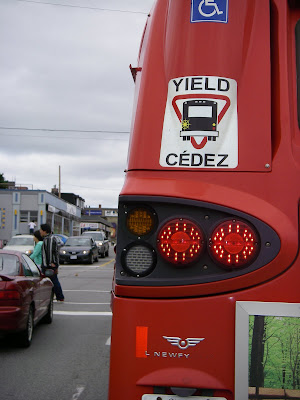 The first one reminds me of the City's "Rail transit plan".
- RG>

 The first one reminds me of the City's "Rail transit plan".
- RG>
Monday, June 30, 2008
The trio that is driving transit ... into the ground
Imagine my surprise when I opened the City section of today's Citizen. My surprise was perhaps multiplied because I had actually spent money to buy this edition, Bridgehead's copies having been filtered away.
Crossing five of six columns on the page C1 was the image of three City managers--Mona Abouhinedy, Vivi Chi, and Nancy Schepers--in a Transitway station. They are dubbed "Three Wise Women of City Hall".
The article, which continues on the second page, rotates between patting these women on the head for being successful, reassuring the reader it's not a gender thing (cough cough), and offering unrelenting worship for their meticulousness.
Pity.
I've come to expect the Citizen's reporting to fall short of where I'd like it go, but such a one-sided story seems to be an endorsement of an apparent flawlessness in the City's Transit "vision". What room is there to criticize the plan if Staff have looked at every detail?
I use the word "vision" loosely, despite the media's relentless reference to a Transit "Plan". A plan, however, would contain detailed costing, timelines, and ridership estimates. In acknowledgement that this is absent, City of Ottawa Press Releases--and even our dictaphobic Mayor--refer to it as a "vision". Which is like calling it a "daydream".
The closest thing to criticism in this article is for the trio's predecessors, who are referred to only as "two white guys" (Rajean Chartrand and Peter Steacy). Bay Ward Councillor Alex Cullen, who chairs the City's Transportation Committee, praises the ladies, saying they differ from their predecessors in that they are not "'over-controlling' of information surrounding their plan, particularly on controversial matters." Indeed, they're not.
These three prefer to merely ignore information they don't like, lest they be accused of controlling it. Council complicitly refuses to insist they provide it.
I speak not of hyperbole. I spoke at length with Vivi Chi at one of the many Open Houses on Transit which have earned these three praise for "openness" in the article. Interestingly, and to their credit, both Nancy Schepers and Alain Mercier had taken the bus to this Open House at Lansdowne Park (I have yet to find a reference to Vivi Chi ever stepping on a bus). Mercier complained at how difficult the transit connection was from OC Transpo headquarters, though I don't think he went so far as to realize that this might be the reason only eight members of the public had been at the Open House there a few days prior.
Now, never minding that the alleged "openness" did not extend to allowing alternate options from being presented at these Open Houses--leaving Councillor Wilkinson to be treated like a blasphemous traitor for parting from canon, despite her proposed map being nearly identical to one of the maps on Staff's own easels.
No, my beef with Ms. Chi--as with most of Council--has to do with buses. Thankfully, the Citizen has started to refer to this proposal as a "bus and rail plan", instead of blindly parroting the popular myth that it suggests that four billion dollars to be spent on rail.
I saw early on that this transit "plan" calls for 63 kilometres of bus Transitway ($900 million), plus $600 million in buses and other bus-related infrastructure. This would be built in the suburbs, to the far reaches of Kanata/Stittsville, Barrhaven and Orleans. When Staff presented the four "options" to Council, they mentioned this bus investment once, briefly, then said they would not raise it again because it was common to all four "options"!
The various reports provided by Staff scarcely mentions this bus investment. One reference in section 3.2 early of one report is explicitly referred to as a "planning assumption" (i.e. not justified; the conclusion of no logically-explained argument).
So I asked Ms. Chi about the blue lines on the map which represented the unbuilt bus Transitway, playing stupid. She told me that Transitway is cheap because all you have to do is lay down some asphalt and you're done. Cheap? Nine hundred million dollars is cheap?!?
I asked why we couldn't simply do today with buses what she plans to do with rail--namely, turning express buses around at Hurdman and Lebreton and forcing people to transfer to a platoon of Transitway buses. She said she was convinced that people will endure a transfer if and only if it is to a "higher order" mode. That is, people will transfer from the Transitway to a Light Rail train because the train is "higher order", but a bus-only trip requires a single-seat ride.
I then asked her why we couldn't build these suburban connections as rail instead. I can't remember which of the common excuses she recited, but the two I've heard before and since were "it's too expensive to build rail to the suburbs" and "there isn't enough density".
But that aside, I asked for her justification for building 63 kilometres of Transitway in the suburbs. What is the cost-benefit? Why were the existing reserved bus lanes insufficient? What is the need? How is busway justified, when the population "isn't dense enough" for rail?
I asked this because of the City's clusterfuck on Woodroffe. Some time ago, a good chunk of Woodroffe Avenue was widened from two lanes to four, with the outer lanes being reserved for bus traffic. As this was a bus facility, these lanes were built with Transit money.
Then, in 2004, for some reason unknown to me, the City built segregated Transitway lanes along the stretch of Woodroffe from West Hunt Club to Fallowfield. This, of course, was also built with Transit funding. Bus riders noticed few differences: the buses along this stretch went no faster than they had been going before (as there was no less non-bus traffic than on the reserved bus lanes), the people who accessed the #95 at the stop in the middle of this stretch could no longer do so, and about 30 seconds were shaved off by the Eastbound bus ride by no longer having to cross at Fallowfield.
Suburban car drivers, however, noticed a vast difference. They now had four lanes, not two, to sprawl through the greenbelt into Downtown. All paid for with Transit infrastructure funding!
The $900 million investment in Transitway is really a misdirection to repeat the Woodroffe Effect in all our suburbs, making our beloved Staff's "Transit vision" into a "rail and bus and road-widening" plan. Councillors Doucet and Chiarelli acknowledged elements of this argument as they voted--rightly--against it.
But I did not take this for granted that this was a singularly malicious and intentional action on Staff's part. I assume that Staff had done their homework and had come up with a good excuse for this. After all, the Citizen article says that this trio are "unassuming, exceedingly meticulous and professional", they are praised for "openness, frankness and honesty" and for having "provided as many details as possible at this stage of the process, including costs"--not counting what the women say about themselves.
So, in her defense, what did Ms. Chi's workbook have to say in defense of this busway investment?
"We figure," she said, burning those two words into my mind, "that people in the suburbs would want to upgrade to a Transitway in the next 25 years." I was floored. The last bit is paraphrased, but I assure you that nine-hundred million dollars of infrastructure investment is being justified with "we figure."
She wasn't even going to give me the courtesy of some bullshit brushoff excuse, like a reference to Chamin Appuhamy, the baby who was killed when the car carrying him was struck by a bus while stopped in a bus lane. Well, credit that to her "openness and honesty". And credit must go to Council for being so explicitly and willfully blind to not notice this!
Councillor Cullen still says it will cost another $4 billion to convert these currently-unbuilt busways to rail, despite Staff having since focused the estimate to $1.5 billion since the $4 billion figure was first floated. No estimate, however, has been provided for the cost of building rail to the suburbs without first building busways. Councillor Leadman had produced an easy-to-follow report (which seems to have disappeared from the internets) for which she sought out these details for herself, despite Staff's insubordinate refusal to assist her in its preparation. (To top it all off, Staff have told Councillor Leadman that they plan on building these bus connections in the first five years of the plan, before solving the downtown mess!)
After a community association meeting, I asked my councillor, Diane Holmes, why she wasn't following Councillor Leadman's lead by insisting that Staff provide a costing out of extending rail to the suburbs. Councillor Holmes said that it would cost too much to build out that far. Funny--how does she know this when staff hasn't provided Council with a cost estimate? I mean, they looked at a fucking bus tunnel, for crying out loud! How can rail to the suburbs be less worthy of consideration than that?!?
All this to say that these women's success is most certainly not a "gender thing". These three women--"two of whom are visible minorities", as the politically-correct article helpfully points out--are clearly able to pull the wool over Councillors' and citizens' (and Citizen's) eyes not only as good as, but much better than the "two white guys" who came before them.
Taxpayers, unfortunately, will be left with nothing but a Mess Transit Plan.
- RG>
Crossing five of six columns on the page C1 was the image of three City managers--Mona Abouhinedy, Vivi Chi, and Nancy Schepers--in a Transitway station. They are dubbed "Three Wise Women of City Hall".
The article, which continues on the second page, rotates between patting these women on the head for being successful, reassuring the reader it's not a gender thing (cough cough), and offering unrelenting worship for their meticulousness.
Pity.
I've come to expect the Citizen's reporting to fall short of where I'd like it go, but such a one-sided story seems to be an endorsement of an apparent flawlessness in the City's Transit "vision". What room is there to criticize the plan if Staff have looked at every detail?
I use the word "vision" loosely, despite the media's relentless reference to a Transit "Plan". A plan, however, would contain detailed costing, timelines, and ridership estimates. In acknowledgement that this is absent, City of Ottawa Press Releases--and even our dictaphobic Mayor--refer to it as a "vision". Which is like calling it a "daydream".
The closest thing to criticism in this article is for the trio's predecessors, who are referred to only as "two white guys" (Rajean Chartrand and Peter Steacy). Bay Ward Councillor Alex Cullen, who chairs the City's Transportation Committee, praises the ladies, saying they differ from their predecessors in that they are not "'over-controlling' of information surrounding their plan, particularly on controversial matters." Indeed, they're not.
These three prefer to merely ignore information they don't like, lest they be accused of controlling it. Council complicitly refuses to insist they provide it.
I speak not of hyperbole. I spoke at length with Vivi Chi at one of the many Open Houses on Transit which have earned these three praise for "openness" in the article. Interestingly, and to their credit, both Nancy Schepers and Alain Mercier had taken the bus to this Open House at Lansdowne Park (I have yet to find a reference to Vivi Chi ever stepping on a bus). Mercier complained at how difficult the transit connection was from OC Transpo headquarters, though I don't think he went so far as to realize that this might be the reason only eight members of the public had been at the Open House there a few days prior.
Now, never minding that the alleged "openness" did not extend to allowing alternate options from being presented at these Open Houses--leaving Councillor Wilkinson to be treated like a blasphemous traitor for parting from canon, despite her proposed map being nearly identical to one of the maps on Staff's own easels.
No, my beef with Ms. Chi--as with most of Council--has to do with buses. Thankfully, the Citizen has started to refer to this proposal as a "bus and rail plan", instead of blindly parroting the popular myth that it suggests that four billion dollars to be spent on rail.
I saw early on that this transit "plan" calls for 63 kilometres of bus Transitway ($900 million), plus $600 million in buses and other bus-related infrastructure. This would be built in the suburbs, to the far reaches of Kanata/Stittsville, Barrhaven and Orleans. When Staff presented the four "options" to Council, they mentioned this bus investment once, briefly, then said they would not raise it again because it was common to all four "options"!
The various reports provided by Staff scarcely mentions this bus investment. One reference in section 3.2 early of one report is explicitly referred to as a "planning assumption" (i.e. not justified; the conclusion of no logically-explained argument).
So I asked Ms. Chi about the blue lines on the map which represented the unbuilt bus Transitway, playing stupid. She told me that Transitway is cheap because all you have to do is lay down some asphalt and you're done. Cheap? Nine hundred million dollars is cheap?!?
I asked why we couldn't simply do today with buses what she plans to do with rail--namely, turning express buses around at Hurdman and Lebreton and forcing people to transfer to a platoon of Transitway buses. She said she was convinced that people will endure a transfer if and only if it is to a "higher order" mode. That is, people will transfer from the Transitway to a Light Rail train because the train is "higher order", but a bus-only trip requires a single-seat ride.
I then asked her why we couldn't build these suburban connections as rail instead. I can't remember which of the common excuses she recited, but the two I've heard before and since were "it's too expensive to build rail to the suburbs" and "there isn't enough density".
But that aside, I asked for her justification for building 63 kilometres of Transitway in the suburbs. What is the cost-benefit? Why were the existing reserved bus lanes insufficient? What is the need? How is busway justified, when the population "isn't dense enough" for rail?
I asked this because of the City's clusterfuck on Woodroffe. Some time ago, a good chunk of Woodroffe Avenue was widened from two lanes to four, with the outer lanes being reserved for bus traffic. As this was a bus facility, these lanes were built with Transit money.
Then, in 2004, for some reason unknown to me, the City built segregated Transitway lanes along the stretch of Woodroffe from West Hunt Club to Fallowfield. This, of course, was also built with Transit funding. Bus riders noticed few differences: the buses along this stretch went no faster than they had been going before (as there was no less non-bus traffic than on the reserved bus lanes), the people who accessed the #95 at the stop in the middle of this stretch could no longer do so, and about 30 seconds were shaved off by the Eastbound bus ride by no longer having to cross at Fallowfield.
Suburban car drivers, however, noticed a vast difference. They now had four lanes, not two, to sprawl through the greenbelt into Downtown. All paid for with Transit infrastructure funding!
The $900 million investment in Transitway is really a misdirection to repeat the Woodroffe Effect in all our suburbs, making our beloved Staff's "Transit vision" into a "rail and bus and road-widening" plan. Councillors Doucet and Chiarelli acknowledged elements of this argument as they voted--rightly--against it.
But I did not take this for granted that this was a singularly malicious and intentional action on Staff's part. I assume that Staff had done their homework and had come up with a good excuse for this. After all, the Citizen article says that this trio are "unassuming, exceedingly meticulous and professional", they are praised for "openness, frankness and honesty" and for having "provided as many details as possible at this stage of the process, including costs"--not counting what the women say about themselves.
So, in her defense, what did Ms. Chi's workbook have to say in defense of this busway investment?
"We figure," she said, burning those two words into my mind, "that people in the suburbs would want to upgrade to a Transitway in the next 25 years." I was floored. The last bit is paraphrased, but I assure you that nine-hundred million dollars of infrastructure investment is being justified with "we figure."
She wasn't even going to give me the courtesy of some bullshit brushoff excuse, like a reference to Chamin Appuhamy, the baby who was killed when the car carrying him was struck by a bus while stopped in a bus lane. Well, credit that to her "openness and honesty". And credit must go to Council for being so explicitly and willfully blind to not notice this!
Councillor Cullen still says it will cost another $4 billion to convert these currently-unbuilt busways to rail, despite Staff having since focused the estimate to $1.5 billion since the $4 billion figure was first floated. No estimate, however, has been provided for the cost of building rail to the suburbs without first building busways. Councillor Leadman had produced an easy-to-follow report (which seems to have disappeared from the internets) for which she sought out these details for herself, despite Staff's insubordinate refusal to assist her in its preparation. (To top it all off, Staff have told Councillor Leadman that they plan on building these bus connections in the first five years of the plan, before solving the downtown mess!)
After a community association meeting, I asked my councillor, Diane Holmes, why she wasn't following Councillor Leadman's lead by insisting that Staff provide a costing out of extending rail to the suburbs. Councillor Holmes said that it would cost too much to build out that far. Funny--how does she know this when staff hasn't provided Council with a cost estimate? I mean, they looked at a fucking bus tunnel, for crying out loud! How can rail to the suburbs be less worthy of consideration than that?!?
All this to say that these women's success is most certainly not a "gender thing". These three women--"two of whom are visible minorities", as the politically-correct article helpfully points out--are clearly able to pull the wool over Councillors' and citizens' (and Citizen's) eyes not only as good as, but much better than the "two white guys" who came before them.
Taxpayers, unfortunately, will be left with nothing but a Mess Transit Plan.
- RG>
Wednesday, February 06, 2008
The skinny on Parking
So I attended today's Transportation Committee meeting to discuss the surprise change in the City's parking policy.
To recap, the surprise was that the changes to the parking policy were implemented as part of the 2008 budget, with scarcely any consultation. The changes were to eliminate the free evening (after 5:30 p.m.) and weekend parking, and to increase the hourly rate from $2.50 to $3. They would also introduce metered parking to three new areas of the city (on Wellington in Hintonburg, on Beechwood, and in Old Ottawa South).
As a cyclist, I really couldn't have cared less about this decision, except that petitions sprung up everywhere to retain free night and evening parking. I was surprised at how much fire erupted from changes to parking regulations, while the annual transit fare increases never really built up any critical mass of energy. I asked myself, rhetorically, "why aren't there any petitions for free transit service on nights and weekends?"
So two weeks ago, when I learned that there would be a meeting of Transportation Committee to discuss (and possibly reconsider) this move, I immediately e-mailed the committee coordinator and asked to be put on the speaker's list. Even though this was a week before the Committee's agenda came out, I still didn't get a chance to make my delegation until after lunch.
By the start of the meeting, 40 people or groups had registered to make a five-minute delegation, and that number approached 50 toward the remainder of the meeting.
Early on, I could tell that I wasn't going to speak at least until after lunch, so I decided to leave for the morning after the second or third delegation, until lunch. Nevetheless, here are some of my observations:
THE CIRCUS
The meeting started off at around 10:10 a.m. with a fifteen-minute-or-so procedural debate.
One councillor moved a motion to suspend the rules of procedure to consider the item in question (this is because it would be a reconsideration of an earlier decision--the 2008 budget--so required a 3/4 majority to be reconsidered). But another councillor (Jacques Legendre, I believe) wanted to defer this decision until after Committee had heard from the delegations.
Legendre's reasoning for deferral was that if Committee ended up not waiving the rules of procedure, Committee wouldn't be able to hear from the delegations. Of course, if they ended up not waiving the rules of procedure, and therefore couldn't reconsider the parking decision, everybody's time would have been wasted sitting through these delegations.
The motion to defer was defeated, and the motion to reconsider was passed.
Next, City Staff (primarily Michael Flainek of the Traffic and Parking Operations branch) presented their report, which was essentially an exercise in justifying this cash-grab after the fact. (Even though I don't mind the fare raises, I still have to agree that it is a cash-grab, and that it wasn't made democratically)
I didn't pay too much attention to it, but two things caught my ear:
- Apparently, evening parking is nearing capacity (which is a good example of a problem for which fee raises would be a reasonable solution. Revenue generation is a bad example)
- Also, apparently for every 10% raise in parking fees, transit use goes up by 1-2% (I didn't write that one down, but it was along those lines.)
THE DELEGATIONS
I took note of some of the more memorable points made during delegations.
Lori Mellor, Preston Street BIA: (paraphrased)
- "We want people who commute by car to stop by on their way to and from work" (Though isn't the City's vision to discourage people commuting by car?)
- "The problem on Saturdays is attracting more customers ... many of our stores aren't open on Saturdays" (So parking fares on Saturdays is going to scare away the customers who currently don't come to your closed stores?)
Peggy Ducharme, Downtown Rideau BIA, Mr. Blatherwick, consultant hired by DRBIA: (started 13:15)
- This BIA (and the merchants it represents) is actually calling for metered parking to be added to their area. This is what metered parking is all about: discouraging staff and lingerers from parking on the street all day, and encouraging opportunities for customers to park.
- They also want to "Reclaim curbside space", by removing bus bays and taxi stands. They later elaborated that they want more flexible street use outside of peak hours.
- They also commissioned Mr. Blatherwick (didn't get his first name) to do a study on parking in the area. The study started last spring and is ongoing.
- According to this study, there is an even split of people who park less than three hours and more than three hours. 55% of customers for the area arrive by car, 14-15% by transit. 1/3 of businesses have most business on weekends, 1/3 during the week, and 1/3 spread evenly between weekends and the week.
Jasna Jennings, ByWard BIA: (13:41-14:00)
- They had 5,000 people sign their online petition. This comment was immediately followed up by a comment that "tens of thousands of people" were getting involved in this debate.
- Jasna's spirited comments elicited applause from the peanut gallery.
- Jasna commented that the estimated increase in revenues is $4.1 million, whereas the cost to implement the changes is over $6 million. Councillor Bloess's responded with a comment that one is from the Operating budget and the other from the Capital budget, and Mr. Flainek pointed out that the Pay & Display machines (one of the bigger parts of the $6M figure) typically pay themselves off after 5 years, and last 10-15 years. Nevertheless, both are being incurred in the 2008 budget. I still don't understand this.
Rev. David Crawley, St. George's Anglican Church (Metcalfe & Gloucester):
- The church issue was a popular one. Churches' big day is Sunday, and their parking parishioners may now be forced to pay for parking. This is compounded because 60% of this congregation's members are from outside the core, and therefore "must" drive.
- Later on, on CBC Radio's All In A Day, host Adrian Harewood spent a lot of time talking about the Church issue (note to self: contact these people next time I want to do an SMAP event!)
- Crawley pointed out that it's not just a Sunday issue. There are events on all nights of the week, including choir practise.
Jacques Legendre played a really dastardly trick on the Reverend. He asked, roughly, "Do you have any suggestions to remedy the situation, specifically with regard to churches?"
He didn't specify what "the situation" was. But his question assumed that the fare increase and extension of hours would be implemented, and that "the problem" is that this will harm churches. Really, "the situation" is that this shouldn't have been done in the first place, and "the problem" can be solved by reversing it.
Unfortunately, Crawley took the bait and responded based on the assumption. He said he couldn't respond purely based on the church angle, because it was a much larger issue.
Doug Casey, Charlesfort Developments: (started 14:13)
- As a developer, Casey wants more people to move downtown.
- He promoted smart growth, perhaps the only presenter to use the term. I didn't hear the term "global warming" (or its variants) once the whole time.
- He pointed out that Kent and Lyon have become extensions of the Queensway, and it's difficult to get anybody to feel at home there, or to have a pedestrian-friendly retail area on those streets
It's interesting he talks about Smart Growth though, because one of the points of Smart Growth is that you put residents and commercial areas in the same place. One of the assumptions in this whole debate is that we apparently want people to live in the suburbs and travel all the way downtown to shop. Not only that, but we want them to take their cars to do it!
If you ask me, deterring people from driving downtown could actually encourage more places to open up in the suburbs, closer to where suburbanites live. After all, suburban houses aren't going to go away.
Gerry LePage, Bank Street BIA: (started 14:23)
- As much as I hate what this guy's BIA does and lobby's council for, his speech today was awesome. For once, I actually agreed with pretty much everything he said. Gerry gets the RealGrouchy Award for Creative Grouchiness for this speech. It was loud, angry, and didn't hold back for the sake of pleasantries.
- Gerry started off by pinning this move on suburban councillors. I'm too lazy to check the votes, but I suspect he's right. (The counterargument that "suburbanites pay when they park downtown, too! Is bullshit, if you ask me)
- He also questioned the attention paid on such a meagre figure, paraphrased: "You can't make $4 million out of a $2 billion budget and all of a sudden the City will stop?" (Though I've heard similar amounts of debate over a mere $50,000)
- "This is not a parking issue, not a financial issue, but a community issue." (paraphrased)
- "Bad policy, in part or in whole, is still bad policy." (paraphrased)
- Mr. LePage sits on the City's Business Advisory Committee, and the Committee was never consulted about this, other than the general consultation on the budget. If individual businesses were notified, it was by the BIAs, not by the City.
- The $6 million expense to implement the changes is a known figure, but how do we know about the $4.1 million projected revenue? Since we don't currently charge for those times, how are we able to predict the traffic patterns? Are the traffic estimates used for the revenue estimates from weekday counts or weekend counts? (an EXCELLENT point).
- The Innes Road area (where Mr. LePage owns a pharmacy) has a higher density of retail space than downtown. At what point does a built up area warrant meters? People who shop downtown are paying a surtax to shop there.
- This last point spurred some debate with Innes Ward Councillor Rainer Bloess. Bloess pointed out that these suburban stores have their own parking, which they must pay for, and that expense must be passed on to the customer.
- Unfortunately, Mr. LePage didn't respond as I would have: First, the suburban stores have lower property tax assessments, and therefore lower taxes. Second, (downtown) stores that don't provide parking have to pay cash-in-lieu-of-parking fees to the City.
- Diane Deans had a long response to Mr. LePage's delegation. In my notes, I summarized it with "boo hoo, my feelings are hurt by your tone." Technically, councillors are only supposed to ask questions of delegations, not make points. Deans' "question" went on for a couple of minutes, and Chair McRae didn't cut her off, as she should have (and often does for urban councillors). During her question, the person next to me asked where the question was. I replied to him "It's a suburban question; it has a long commute."
LePage's point, which he iterated in response to Deans' hurt feelings, was this: He wants an equitable parking policy. What is presented here is analagous to a surtax on downtown.
When you factor in the Province's recent refusal to address the property tax inequity, I must say that I agree 100% that suburbs are getting a free ride on the backs of downtowners.
THE RESULT:
I left after LePage's consultation, but the meeting disposition (a record of what decisions were made, which is available before the formal minutes) is available on the City's website here. The minutes will be posted on this page when they are available.
I saw them this afternoon, and I laughed out loud:
So, in order to solve the problem of an unexpected rate increase from $2.50 to $3.00, they raised it to $3.25! That is so hilarious I laughed out loud.
Now, this is just the Committee's recommendation to Council. Council will still have to go through the same rigmarole, but without the delegations.
And at the end of the day, I'm a cyclist who's only paid for parking once in his entire life, and I don't really care how this ends up. So all I can really do is sit back, watch, and laugh at the hilarious hole that Council will inevitably dig deeper.
- RG>
To recap, the surprise was that the changes to the parking policy were implemented as part of the 2008 budget, with scarcely any consultation. The changes were to eliminate the free evening (after 5:30 p.m.) and weekend parking, and to increase the hourly rate from $2.50 to $3. They would also introduce metered parking to three new areas of the city (on Wellington in Hintonburg, on Beechwood, and in Old Ottawa South).
As a cyclist, I really couldn't have cared less about this decision, except that petitions sprung up everywhere to retain free night and evening parking. I was surprised at how much fire erupted from changes to parking regulations, while the annual transit fare increases never really built up any critical mass of energy. I asked myself, rhetorically, "why aren't there any petitions for free transit service on nights and weekends?"
So two weeks ago, when I learned that there would be a meeting of Transportation Committee to discuss (and possibly reconsider) this move, I immediately e-mailed the committee coordinator and asked to be put on the speaker's list. Even though this was a week before the Committee's agenda came out, I still didn't get a chance to make my delegation until after lunch.
By the start of the meeting, 40 people or groups had registered to make a five-minute delegation, and that number approached 50 toward the remainder of the meeting.
Early on, I could tell that I wasn't going to speak at least until after lunch, so I decided to leave for the morning after the second or third delegation, until lunch. Nevetheless, here are some of my observations:
THE CIRCUS
The meeting started off at around 10:10 a.m. with a fifteen-minute-or-so procedural debate.
One councillor moved a motion to suspend the rules of procedure to consider the item in question (this is because it would be a reconsideration of an earlier decision--the 2008 budget--so required a 3/4 majority to be reconsidered). But another councillor (Jacques Legendre, I believe) wanted to defer this decision until after Committee had heard from the delegations.
Legendre's reasoning for deferral was that if Committee ended up not waiving the rules of procedure, Committee wouldn't be able to hear from the delegations. Of course, if they ended up not waiving the rules of procedure, and therefore couldn't reconsider the parking decision, everybody's time would have been wasted sitting through these delegations.
The motion to defer was defeated, and the motion to reconsider was passed.
Next, City Staff (primarily Michael Flainek of the Traffic and Parking Operations branch) presented their report, which was essentially an exercise in justifying this cash-grab after the fact. (Even though I don't mind the fare raises, I still have to agree that it is a cash-grab, and that it wasn't made democratically)
I didn't pay too much attention to it, but two things caught my ear:
- Apparently, evening parking is nearing capacity (which is a good example of a problem for which fee raises would be a reasonable solution. Revenue generation is a bad example)
- Also, apparently for every 10% raise in parking fees, transit use goes up by 1-2% (I didn't write that one down, but it was along those lines.)
THE DELEGATIONS
I took note of some of the more memorable points made during delegations.
Lori Mellor, Preston Street BIA: (paraphrased)
- "We want people who commute by car to stop by on their way to and from work" (Though isn't the City's vision to discourage people commuting by car?)
- "The problem on Saturdays is attracting more customers ... many of our stores aren't open on Saturdays" (So parking fares on Saturdays is going to scare away the customers who currently don't come to your closed stores?)
Peggy Ducharme, Downtown Rideau BIA, Mr. Blatherwick, consultant hired by DRBIA: (started 13:15)
- This BIA (and the merchants it represents) is actually calling for metered parking to be added to their area. This is what metered parking is all about: discouraging staff and lingerers from parking on the street all day, and encouraging opportunities for customers to park.
- They also want to "Reclaim curbside space", by removing bus bays and taxi stands. They later elaborated that they want more flexible street use outside of peak hours.
- They also commissioned Mr. Blatherwick (didn't get his first name) to do a study on parking in the area. The study started last spring and is ongoing.
- According to this study, there is an even split of people who park less than three hours and more than three hours. 55% of customers for the area arrive by car, 14-15% by transit. 1/3 of businesses have most business on weekends, 1/3 during the week, and 1/3 spread evenly between weekends and the week.
Jasna Jennings, ByWard BIA: (13:41-14:00)
- They had 5,000 people sign their online petition. This comment was immediately followed up by a comment that "tens of thousands of people" were getting involved in this debate.
- Jasna's spirited comments elicited applause from the peanut gallery.
- Jasna commented that the estimated increase in revenues is $4.1 million, whereas the cost to implement the changes is over $6 million. Councillor Bloess's responded with a comment that one is from the Operating budget and the other from the Capital budget, and Mr. Flainek pointed out that the Pay & Display machines (one of the bigger parts of the $6M figure) typically pay themselves off after 5 years, and last 10-15 years. Nevertheless, both are being incurred in the 2008 budget. I still don't understand this.
Rev. David Crawley, St. George's Anglican Church (Metcalfe & Gloucester):
- The church issue was a popular one. Churches' big day is Sunday, and their parking parishioners may now be forced to pay for parking. This is compounded because 60% of this congregation's members are from outside the core, and therefore "must" drive.
- Later on, on CBC Radio's All In A Day, host Adrian Harewood spent a lot of time talking about the Church issue (note to self: contact these people next time I want to do an SMAP event!)
- Crawley pointed out that it's not just a Sunday issue. There are events on all nights of the week, including choir practise.
Jacques Legendre played a really dastardly trick on the Reverend. He asked, roughly, "Do you have any suggestions to remedy the situation, specifically with regard to churches?"
He didn't specify what "the situation" was. But his question assumed that the fare increase and extension of hours would be implemented, and that "the problem" is that this will harm churches. Really, "the situation" is that this shouldn't have been done in the first place, and "the problem" can be solved by reversing it.
Unfortunately, Crawley took the bait and responded based on the assumption. He said he couldn't respond purely based on the church angle, because it was a much larger issue.
Doug Casey, Charlesfort Developments: (started 14:13)
- As a developer, Casey wants more people to move downtown.
- He promoted smart growth, perhaps the only presenter to use the term. I didn't hear the term "global warming" (or its variants) once the whole time.
- He pointed out that Kent and Lyon have become extensions of the Queensway, and it's difficult to get anybody to feel at home there, or to have a pedestrian-friendly retail area on those streets
It's interesting he talks about Smart Growth though, because one of the points of Smart Growth is that you put residents and commercial areas in the same place. One of the assumptions in this whole debate is that we apparently want people to live in the suburbs and travel all the way downtown to shop. Not only that, but we want them to take their cars to do it!
If you ask me, deterring people from driving downtown could actually encourage more places to open up in the suburbs, closer to where suburbanites live. After all, suburban houses aren't going to go away.
Gerry LePage, Bank Street BIA: (started 14:23)
- As much as I hate what this guy's BIA does and lobby's council for, his speech today was awesome. For once, I actually agreed with pretty much everything he said. Gerry gets the RealGrouchy Award for Creative Grouchiness for this speech. It was loud, angry, and didn't hold back for the sake of pleasantries.
- Gerry started off by pinning this move on suburban councillors. I'm too lazy to check the votes, but I suspect he's right. (The counterargument that "suburbanites pay when they park downtown, too! Is bullshit, if you ask me)
- He also questioned the attention paid on such a meagre figure, paraphrased: "You can't make $4 million out of a $2 billion budget and all of a sudden the City will stop?" (Though I've heard similar amounts of debate over a mere $50,000)
- "This is not a parking issue, not a financial issue, but a community issue." (paraphrased)
- "Bad policy, in part or in whole, is still bad policy." (paraphrased)
- Mr. LePage sits on the City's Business Advisory Committee, and the Committee was never consulted about this, other than the general consultation on the budget. If individual businesses were notified, it was by the BIAs, not by the City.
- The $6 million expense to implement the changes is a known figure, but how do we know about the $4.1 million projected revenue? Since we don't currently charge for those times, how are we able to predict the traffic patterns? Are the traffic estimates used for the revenue estimates from weekday counts or weekend counts? (an EXCELLENT point).
- The Innes Road area (where Mr. LePage owns a pharmacy) has a higher density of retail space than downtown. At what point does a built up area warrant meters? People who shop downtown are paying a surtax to shop there.
- This last point spurred some debate with Innes Ward Councillor Rainer Bloess. Bloess pointed out that these suburban stores have their own parking, which they must pay for, and that expense must be passed on to the customer.
- Unfortunately, Mr. LePage didn't respond as I would have: First, the suburban stores have lower property tax assessments, and therefore lower taxes. Second, (downtown) stores that don't provide parking have to pay cash-in-lieu-of-parking fees to the City.
- Diane Deans had a long response to Mr. LePage's delegation. In my notes, I summarized it with "boo hoo, my feelings are hurt by your tone." Technically, councillors are only supposed to ask questions of delegations, not make points. Deans' "question" went on for a couple of minutes, and Chair McRae didn't cut her off, as she should have (and often does for urban councillors). During her question, the person next to me asked where the question was. I replied to him "It's a suburban question; it has a long commute."
LePage's point, which he iterated in response to Deans' hurt feelings, was this: He wants an equitable parking policy. What is presented here is analagous to a surtax on downtown.
When you factor in the Province's recent refusal to address the property tax inequity, I must say that I agree 100% that suburbs are getting a free ride on the backs of downtowners.
THE RESULT:
I left after LePage's consultation, but the meeting disposition (a record of what decisions were made, which is available before the formal minutes) is available on the City's website here. The minutes will be posted on this page when they are available.
I saw them this afternoon, and I laughed out loud:
a. that the 2008 rates and hours for on-street parking be adjusted so that :
i. There is no charge for Sunday parking in commercial areas of the City;
ii. Hours are reduced for on-street parking to 7:00 p.m. Monday to Saturday; and
iii. The rate for on-street parking increase to $3.25/hour beginning October 1, 2008...
So, in order to solve the problem of an unexpected rate increase from $2.50 to $3.00, they raised it to $3.25! That is so hilarious I laughed out loud.
Now, this is just the Committee's recommendation to Council. Council will still have to go through the same rigmarole, but without the delegations.
And at the end of the day, I'm a cyclist who's only paid for parking once in his entire life, and I don't really care how this ends up. So all I can really do is sit back, watch, and laugh at the hilarious hole that Council will inevitably dig deeper.
- RG>
Tuesday, January 08, 2008
More photos from today...
My cousin came up from Texas, so we spent the afternoon going about town. There was no shortage photo opportunities today. I'm bunching them up into one long blog post for convenience. Click on photos to see larger versions (7 MPixel, ~2MB).
First off, there was the fog. Beautiful, beautiful fog. Here's a shot of Central Park from Bank Street (taken around 2pm, though you wouldn't know it to see it):

Another thing I saw is Para Transpo's new livery. In fact, it looks like new vehicles, too. I had noticed one a couple days ago, but couldn't snap a photo in time.
Background: As of January 1, 2008, Para Transpo is now operated directly by the City of Ottawa (whose transportation department was the only bidder on the RFP). The contract with FirstBus Canada to deliver the transit service for people with special mobility needs ran out at the end of the year.

Next up is a photo I took last night. I bring my bike into my house (for both security and convenience), and in the winter, even though I brush off as much snow as I can, it still drips onto the floor. So I have a couple floor mats to collect the salty water.
While cleaning these mats last night, I noticed that the salt had crystallized on the ridges of the floor mat as the water evaporated--thick enough that it came off in chunks. I thought it was pretty cool, and snapped a photo before cleaning it off (the camera's flash was too bright and the room light too dim, so I used a flashlight):

Almost done...
We walked up Sparks street, and I noticed the Ottawa Electric Building for the first time. Walking back on Queen Street, I noticed something even stranger. It must be the narrowest building in Ottawa. At only about three or four brick-lengths across, this red (former) building is squeezed between the Ottawa Electric Building and the NCC headquarters in the Bell Block (see page 28 of this magazine (PDF)--in fact, I recommend the OCA's Construction Comment magazine for its full-colour photos of area construction sites and Ottawa architectural history):

Lastly, as we left the restaurant on Preston Street and headed to the bus stop on Carling, we noticed a neat etching in the pavement (akin to people's initials, but less egotistical):

Hope you enjoyed them!
- RG>
First off, there was the fog. Beautiful, beautiful fog. Here's a shot of Central Park from Bank Street (taken around 2pm, though you wouldn't know it to see it):

Another thing I saw is Para Transpo's new livery. In fact, it looks like new vehicles, too. I had noticed one a couple days ago, but couldn't snap a photo in time.
Background: As of January 1, 2008, Para Transpo is now operated directly by the City of Ottawa (whose transportation department was the only bidder on the RFP). The contract with FirstBus Canada to deliver the transit service for people with special mobility needs ran out at the end of the year.

Next up is a photo I took last night. I bring my bike into my house (for both security and convenience), and in the winter, even though I brush off as much snow as I can, it still drips onto the floor. So I have a couple floor mats to collect the salty water.
While cleaning these mats last night, I noticed that the salt had crystallized on the ridges of the floor mat as the water evaporated--thick enough that it came off in chunks. I thought it was pretty cool, and snapped a photo before cleaning it off (the camera's flash was too bright and the room light too dim, so I used a flashlight):

Almost done...
We walked up Sparks street, and I noticed the Ottawa Electric Building for the first time. Walking back on Queen Street, I noticed something even stranger. It must be the narrowest building in Ottawa. At only about three or four brick-lengths across, this red (former) building is squeezed between the Ottawa Electric Building and the NCC headquarters in the Bell Block (see page 28 of this magazine (PDF)--in fact, I recommend the OCA's Construction Comment magazine for its full-colour photos of area construction sites and Ottawa architectural history):

Lastly, as we left the restaurant on Preston Street and headed to the bus stop on Carling, we noticed a neat etching in the pavement (akin to people's initials, but less egotistical):

Hope you enjoyed them!
- RG>
Wednesday, December 19, 2007
Bank/Somerset Re-opening
Going home tonight, I stopped by the Somerset House site, and noticed some changes. There were Jersey barriers around the site, and some of the barricades had been removed. Sure enough, at around 11pm, an article appears on the Citizen's website announcing this intersection will re-open.
Here are my photos from my visit tonight (I also have many photos from previous visits that I have not blogged):

- RG>
Here are my photos from my visit tonight (I also have many photos from previous visits that I have not blogged):

- RG>
Subscribe to:
Posts (Atom)
