Monday, January 19, 2026

Shrink rap

My psychiatrist gets a bad rap. Mostly from me. I'll get back to that.

In the last week or so, I've had a bout of unexpected energy and drive to get things done, as though I've woken up from a long slumber.

That's actually not far off from the truth; I've been feeling tired for quite some time, and it's been particularly bad since I got COVID-19 again over the Christmas 2024 holidays (that's right, over a year). I thought at the time it was due to a stressful work situation, but when that improved my fatigue did not.

I got bloodwork and an ECG done, with nothing standing out. And my shrink kept prescribing me with more and more stimulants to try to help me stay awake, with little success.

But actually, my history with fatigue goes back much farther.


Like many people in Ontario, I don't have a family doctor, but I used to. My interactions with Dr. Fuckit, as I'll call her, left much to be desired:

When I told her I thought I might have ADHD, she asked, "did you Google it?" (not in a "Tsk, tsk, don't believe everything you see on the internet" sort of way, but as in "So? Go figure it out yourself. What do you want me to do?") No, doctor, I didn't Google it; I came to, you, ostensibly a medical professional, to seek advice. When did that stop being what you're supposed to do? She prescribed me some medication and sent me on my way.

It was the same Dr. Fuckit who, when I asked years ago why I was so tired all the time, she replied "well, maybe it's just you", shutting down my hope of doing anything about it.

It's just as well that she left the practice. And that practice, being a Family Health Team, kept me on as a patient just as when my previous doctor left. However even though the corresondence from the time suggests I got a new doctor in her place, I would only see Nurse Practitioners at the practice for primary care instead.

These nurse practitioners were a fair bit more helpful. There was one I remember seeing for some other matter, and when at the end of the appoinment she asked if there was anything else, I just blurted out sarcastically, "well not unless you can do anything about my fatigue," thinking back to the doctor's suggestion that nothing could be done. The strangest thing happened: she took the matter seriously and gave me some advice on things I could try: more exercise, more fibre, and better sleep hygiene. I didn't expect the world to change overnight, but it was worth a shot.

The next day, the world shut down due to the COVID-19 pandemic.

Fast forward a year, and my fatigue was joined by an utter lack of motivation, which was affecting both my work life and my home life. In a video call, my nurse practitioner told me that my bloodwork didn't show anything out of place, referred me to a psychiatrist on the family health team, and offered me some medication options. We chose a medication called "Abilify" (aripiprazole) to supplement the depression/ADHD meds I'd been on for years.

That was the first medical appointment where I started taking notes, which is helpful because everything I wrote about what happened earlier is... let's say "inspired by true events".

I don't have any notes from the follow up call because I was driving, but I remember it well. I was on Carling, turning left onto Bronson. She asked me how it was going with the new medication and I nearly broke down into tears. After so many years of living with "maybe it's just me", I told her that after starting this medication, I could be present for my work, friends, and most importantly, my family. I told her it was like night and day. This little miracle drug that does what it says on the tin: "Abilify"


I'd seen psychiatrists before. All through high school, I had regular hour-long psychotherapy (talk) appointments with one for depression. In university, I saw a different one, who eventually concluded that I had more or less figured things out and didn't really need the appointments anymore.

The new one, he's different. I'll call him Dr. Whatever. To start with, the appointments are only by phone, what with a pandemic and all, so I've never met him in person. He might have introduced himself on our first call, but subsequently, he'd just open the call with "hi, how's it going" as though my ADHD would ever let me to connect an incoming call from a private number with the fact that I had an appointment with a doctor that day (plus, like, who the fuck calls somebody and doesn't say who's calling?). His voice sounds exactly like my uncle's, which one time meant I got a few minutes into chatting with him before I realized he was asking doctor questions and not uncle questions.

Also making it harder to identify him as the caller is that he often calls anywhere from 30-90 minutes after the scheduled start time, by which time I've long forgotten that I had an appointment (I'm not exactly sitting by the phone waiting for his call). This means I have to block off my whole morning at work for my appointments to ensure I won't be in a meeting when he calls. The whole morning, for a call that sometimes goes as long as 10 minutes.

So anyway, the first appointment, we talk about fatigue, high-functioning, low motivation. He'll refer me to a sleep study at the Royal. I asked if increasing my Abilify might help, and he said I probably wouldn't get anything out of increasing it (but then he increased my dose anyway).

I remember asking him about getting a proper diagnosis. I know I'm neurodivergent: I was in the gifted programme in grade school, I certainly have a lot of the symptoms of ADHD, and I have strong opinions on punctuation. I felt it would help me understand my brain better if I were properly diagnosed (what I would later learn is called a "neuropsychological assessment"). And I also remember him shrugging off my request and saying something dismissive about "labels". He prescribed me some stimulants to help with the fatigue.

I had regular appointments with him every month or two. The sleep study came and went, nothing abnormal there. The fatigue remained. Here, have some more stimulants. Still not working? Try taking more per day. No? Try adding this other one. I tapered off my antidepressants for a while at one point to see if that did anything and concluded I should go back on them.

And even though he was the doctor and I was the one with ADHD, I had to be organized enough to remind him to renew my prescriptions for all of these meds. Oftentimes he would renew some, but not all of them. Or he'd remember one dose but not the other dose that I take at a different time of day.

I got pretty good at reminding him, because when my refills run out, it takes multiple faxes from my pharmacy and multiple follow-up calls from me (each time first calling the pharmacy to confirm it still hasn't come through) before he finally sends it in. By this point it's out of sync with my other refills that I had carefully coordinated so I don't have to make several trips per month to the pharmacy. But more than once I've had to ask the pharmacist (such a helpful, understanding person!) to give me a few days' worth to cover me off until my next appointment because Dr. Whatever hadn't responded to the refill requests.

Can we just take a moment to appreciate the fact that this is probably the worst doctor for people with ADHD, who are easily distracted, have difficulty remembering things, get easily distracted, and easily forget appointments? The cruelty of being in a situation where I have to overcome classic traits of ADHD and be hyper-organized to compensate not just for my own shortcomings, but for my doctor's too?

Fast forward to a couple of months ago. I had an appointment in early November, but on the day of my appointment I got a notification that my appointment had been rescheduled... to January! I promptly called the office to inform them that a couple of my medications wouldn't last that long and could he please send a refill to the pharmacy. Nothing happened. By December, he still hadn't called in the prescriptions, so I got the pharmacy to send another fax and I called the office again (or at least I tried. Most of the times I remembered to call it was while their receptionist was on lunch or outside their business hours). It was getting close to Christmas, and I could tell that one of my meds would definitely run out over the holidays, and with Abilify coming close. Finally, on Christmas Eve, after telling the receptionist that I would need to start rationing my pills so that I would have enough to be functional on my first week back at work before my appointment, I got a call from the pharmacy that my prescription was ready.

Relief.

Except, he only refilled the prescription for the stimulant. As my appointment got closer, I realized that my Abilify would run out a day or two before.

That's no big deal, I thought. I can last a day or two without it and then pick up my meds after he sends in a refill after my appointment.

And then my January appoinment was rescheduled to the end of the month.

Fuck!


After some prompt hounding on the day of my appointment, I managed to get the doctor's office to send in the refill to the pharmacy, who refilled it.

I didn't feel like picking it up on the Friday though. Then it snowed on the weekend and I didn't want to go out.

Then I felt too busy at work on Monday to go. I'd been busy on the weekend, too.

And not just busy, but productive. I had a sudden drive to spend my workday just keeping doing work. And energy.

The last week or so I've been actually working on personal projects instead of wasting away all of my free time on snacking, watching YouTube, playing mindless phone games, and napping!

Something was different. What the hell was going on?

Over the last few months, after watching many YouTube videos about ADHD, I came across a channel called "Auticate with Chriss ∧ Debby" who talked about something called "AuDHD", a combination of autism and ADHD, two diagnoses with seemingly contradictory symptom profiles, that is more than the sum of its parts. The description fit me to a T. I started watching their videos, and others on the topic, and kept learning more and more.

So maybe I had ADHD and autism? Has that been the case all along? Why did I have to learn about this through a fucking YouTube video? Oh, right, because my psychiatrist didn't want to help me pin down a diagnosis because doesn't care about "laaaaabels." THAT LABEL WOULD HAVE BEEN REALLY HANDY FOUR YEARS AGO, BUDDY!

This got me thinking about how my life might have been different if I had known this a lot earlier. Was it just a coincidence that my parents had so many friends with kids on the spectrum? (I mean, likely yes; there was no thing as a "spectrum" and all of their friends' kids had much more prominent signs that if anything worked against identifying anything in me) Was my "gifted" status a misdiagnosis? Or does it still apply, piled on top of the other neurodivergences? What about the depression diagnosis? WHY COULDN'T DR. FUCKIT HAVE REFERRED ME TO A HUMAN DOCTOR FOR A DIAGNOSIS INSTEAD OF TO FUCKING GOOGLE?!?

So how could I tell if not stopping the Abilify triggered this energy? I took my doctor's advice: I googled it.

Specifically, I reviewed reputable websites' information about drug interactions and side effects for each of my brain medications. "No known interactions" for Abilify. Nor for any of the others. Strange.

And as if "did you Google it" wasn't bad enough advice a decade ago, the answer this past week came from an AI summary: Abilify (used to treat ADHD) and stimulants, "have opposing mechanisms of action (one is an antipsychotic, the other a stimulant) that can produce combined side effects". Sigh. (Oh, also while editing this I also found an AI search summary that said combining Abilify with my antidepressant can worsen side effects like fatigue and insomnia, but that "doctors monitor [their patients] closely due to these significant interactions." Oh, sweet, innocent, society-destroying AI summary...)

The best I can conclude is that Dr. Whatever prescribing me more and more stimulants was like adding more wind to a sailboat with no sail. As soon as the Abilify stopped, the sail went back up, and whoosh! Off went my brain at a mile a minute. Despite helping with my motivation when I started it, by now felt was more like it should be called "Disabilify" or "Fatiguify".

Why did Dr. Whatever never think of Abilify as the cause of my fatigue? Maybe because I'd gone off Abilify before, and each time concluded that I was better off on it? But we'd never tried dropping it since we added all the stimulants. My nurse practitioner didn't notice it when I went to discuss my lab test results with her, but maybe she would have if Dr. Whatever had bothered to let her know that he'd ordered the tests and why, so she could have come to the appointment prepared. I didn't think of it because I associated it with the seemingly miraculous effect it had when I first started taking it.

So maybe I'm too hard on Dr. Whatever. Maybe he gets a bad rap and he's actually thinking four steps ahead—

NO! HE'S NOT! This was entirely an accident due to his incompetence! His only answer was to keep pumping more stimulants! Starting or stopping medication (willingly or otherwise) without discussing it with your doctor is a terrible idea! (As is doing so based on reading some random blog, in case you're getting any ideas) Four steps ahead? If he deliberately postponed my appointments to force me off Abilify without discussing it with him first, that would be even worse! I'd report him for malpractice if it weren't for the power dynamic whereby I need him for continued access to my meds! Or if there weren't a severe shortage of doctors in this province! Exclamation points for emphasis!!!

Oh, and to top it all off, when I reviewed my old notes to write this up, there in the margin of my notes from my very appointment with the nurse practitioner who introduced me to Abilify, is a note in my own handwriting: "can be sedating".

Facepalm. It was there all along.


If Dr. Whatever hadn't postponed my early January appointment, I would have been off Abilify for a day or two already by the time I picked up the prescription, which might have been long enough to start feeling different and come to the same conclusion. I don't know where I'd be if he hadn't cancelled the November appointment. I mean, he was trying, by ordering blood work and a sleep study, but the solution he hadn't tried was sitting right there on his prescription pad.

I'm not taking it for granted that going off Abilify is an all-around good thing. It's unleashed the full power of my ADHD, which for now feels like a superpower but I was taking it to address a problem and maybe that problem will come back. Will the energy fade? Will other symptoms crop up? Will hyperfocus compromise my personal life? I guess only time will tell, since at this point I don't expect Dr. Whatever to.

Maybe Dr. Whatever keeps postponing my appointments because he now realizes I'm going to read him the fucking riot act (or maybe this blog post) the next time I talk to him.

I'm bitter about a year or more of lost productivity, of lost time spent doing things I enjoy, of looking for a new job in hopes the change would make me feel better, of wondering if something was fundamentally and incurably wrong with me.

I'm bitter about four years of not learning I (probably) have AuDHD, and not understanding the implications, because of Dr. Whatever's apathy toward "labels". I remember being asked on medical forms about whether I've been diagnosed with anything, and I genuinely don't know because Dr. Fuckit and Dr. Whatever have just given me medication after I've speculated that I'm depressed, or have ADHD, or whatever, but no doctor has actually told me, "you have these conditions."

I'm bitter that I have to become an expert, and an advocate on my own behalf, and that I have to remind my own doctor to do his job, all so I can try to manage a condition whose major symptoms include difficulty in doing these very things. I have a whole "family health team" yet I feel alone in my medical journey. (I've inquired about getting a new psychiatrist and was told that was not possible)

And I'm bitter that I don't have a proper psychotherapist to help me talk through these issues. Maybe if I did I wouldn't feel compelled to rant about it on my blog.

Okay... let me take a breath.

At least I'm not out of pocket (beyond transit fare) for any of my medical appointments, and my job's benefits plan brings the cost of my meds down to a reasonable price. I also have a job where I can usually step away for a bit when my brain decides to turn off.

I'm cautiously optimistic about my recent bout of energy after dropping Abilify (which, I must remind myself, really helped me when I started taking it), but because I'm terrified that this energy will not last, I've been setting aside other things (like keeping my work area tidy or going outside) to finish some projects while I can. At the same time, maybe I don't need so many stimulants now that their effects aren't being nullified.

I feel like my brain is moving faster and probably burning more calories, while the hyperfocus is helping me avoid snacking reflextively, and the energy is helping me go out and get more exercise: maybe I'll be able to work off the significant weight I've gained over the last couple of years. But I've also noticed that I've felt an obsessive urge to work on both my work and personal projects (like writing this blog post, which ironically is longer than my attention span would let me finish reading). While this is better than having no motivation at all, it risks keeping me from going out and enjoying life just as much as constant fatigue used to.

I'm hopeful that my productivity persists, and that I'm able to take advantage of it where I can and keep it under control when I need to.

With any luck, this new energy will last and I'll be able to get on with my life.

And maybe I'll even go out and get a new shrink.

Sunday, September 01, 2019

It's not always about You

I make a point of not doing that thing when you talk in the second person when you're actually talking about yourself.

See what I did there?

If you didn't, be careful reading on because you might start seeing it a lot. Many people don't notice it when they hear it, much less out of their own mouths.


I remember when I first encountered this. It was in French class in about grade two, and the teacher was telling us about the different pronouns: je, tu, il/elle/on... "on". He had to explain to us the meaning of "on", the third person singular, which is common in French but obscure in English.

In English, the equivalent would be "one"; specifically, the third definition under the heading "pronoun" on Oxford's online definition of "one" (as in "one does not simply walk into Mordor"). Our French teacher tried describing this to us, but many of us seven year olds hadn't yet encountered it in English (or at least not that we'd recognized).

So he tried again, describing the generic "you". "you know how some people will say 'you always have to look both ways before crossing the street'" and I thought (particularly after having just been told that "tu" is for the second person) that that was such a peculiar way of saying things. Also, no, I hadn't encountered that either.

Clearly, I eventually caught on to the meaning of "one" and its distinctness from "you", as one does (or as you do), and I never let go of that feeling that said that this was a strange and unnecessary way of using "you" when there's a perfectly unambiguous alternative.


I don't remember when I started noticing people using the generic "you"; likely after I was exposed to Orwell's wonderfully succinct treatise Politics and the English Language in high school. And it was probably not so much when it was used as a replacement for "one"—which makes sense in context—as when the speaker bastardizes even the generic "you" in order to refer to their own behaviour.

I had a colleague who did it all the time. In a one-on-one conversation, she would be telling an anecdote and she'd say "So I do that thing where you always check your phone when getting on the bus..." instead of simply saying "I always check my phone when getting on the bus...". This would derail my train of thought, even though it was often an aside to her main point (e.g. "...and I realized this morning when I got on the bus that I forgot my phone at home"). Not only does she change from first person to second person in the middle of the sentence, but she's also describing—to me, in the point of view that refers to me—something that I don't do myself.

I'm sure there's something psychological about it, and I have a few theories:
- because you're describing something you do regularly you fall back on phrasing used for generic activities
- you'd feel awkward saying "I eat breakfast every morning" when the listener might get the impression you think you're the only one who does this common activity
- you don't want to say "I put milk on my oatmeal" in case the other person doesn't do it too, so you describe it as a general behaviour to normalize it, hopefully averting a conversation about whether or not it's normal to put milk on porridge.

Of course, the first two are situations where you could use "one", the pronoun specifically designed for this situation, and you were just too lazy to do so. The third situation reflects a lack of confidence—and it could even be aggressive!

Imagine you're in an office setting and a colleague is telling you an anecdote about chewing gum. In introducing the topic they describe "that thing where you chew gum really loudly in public..." You realize that you chew gum in the office, and maybe it's actually annoying your colleagues and this is their way of pointing it out to you. Forget the rest of their anecdote, you're not listening any more. Instead you're getting self-conscious. Is your loud gum-chewing so notorious around the office that your colleague can mention it so offhandedly? You didn't think you chewed your gum loudly... sorry, what was that last bit?

"... and then spit it out onto the sidewalk?" Oh, it wasn't about me. What a relief!

It can also be deliberately passive-aggressive by normalizing something that the listener should do, thus putting them down if they happen not to: "you know how you're not supposed to put two spaces after a period anymore because we no longer type in fixed-width fonts? Well anyway, I got a resume today where he put three!" (Some people still do put two spaces after a period, and yes, I'm calling it out!)

Orally, one's intonation can usually distinguish between the general "you know how you have two ears" and the specific "you know how you always leave the toilet seat up," but telling these apart can be harder in print. This has only gotten worse as people tend to write more the way they speak, but without the added contextual cues that come with spoken language.


There are other situations where the pronoun is dropped altogether. Sue Sherring did it a lot when she wrote for the Ottawa Sun, before it merged with the Citizen and she subsequently left. I didn't have to go far to find an example on her blog, in the most recent post. This is the full paragraph:
"Simply can’t think of a more appropriate name for a park honouring Rabbi Bulka."
Clearly in from the context, including that it's her personal blog, the pronoun would be "I". Regardless of that, both "you" or "one" would also fit in here and mean the same thing. But you can imagine situations where it's really not clear whether she's talking about herself or the article's subject (and you'll have to imagine them because I can't find any at the moment, even though I thought I had collected or emailed myself some samples that I can't find).

While this is sloppy style for a print newspaper, I've found myself having dropped the subject in jotted notes, which are by their nature somewhat sloppy. Later, I'd have difficulty figuring out whether, when I wrote "sent email", I meant that I sent an email to the person or they sent one to me. Sometimes during the slow parts of a meeting I'll reread the notes I've taken so far and I'll catch these while the context is still fresh in my mind, and squeeze in some clarifying additions.


Once at a summer camp, we had oatmeal for breakfast, and the toppings were making their rounds on the table. Brown sugar, for sure. The kid next to me put milk over his oatmeal (as I was accustomed to doing myself) and passed the milk jug to me. As I started to tilt the jug over my bowl, one of the other children called him out: "you put milk on your oatmeal?!?" and before a drop fell out I deftly moved the milk jug over to my empty glass, lest I repeat the apparent faux pas.

In retrospect, I could have defended him, but peer pressure is such a powerful thing when one is a child at a summer camp.

I suppose I could have replied, "yeah. You know how you put milk on oatmeal?"

- RG>

Saturday, January 23, 2016

RG's workshop: Record crate

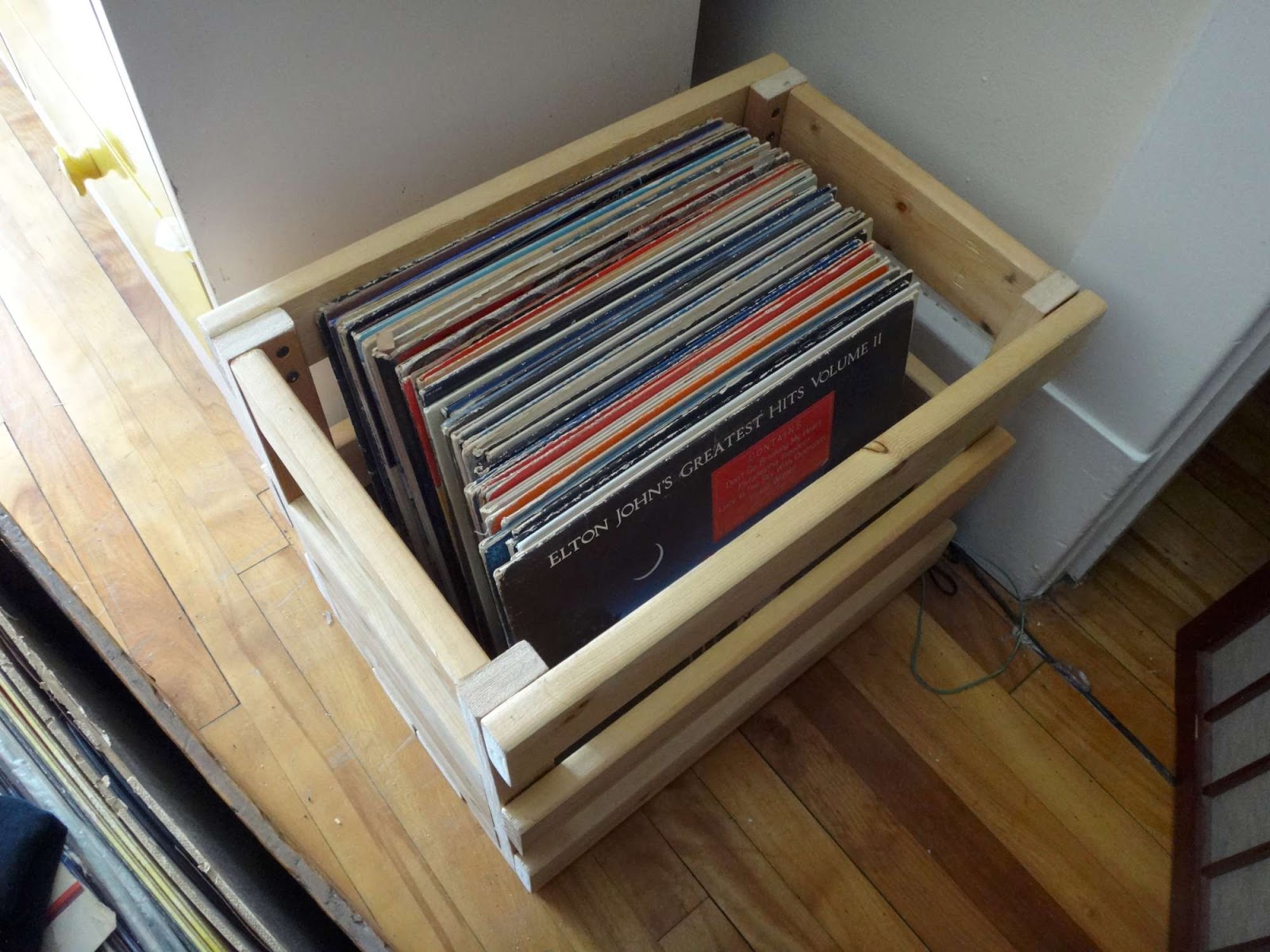
I have an old wooden crate that is the perfect size for holding records, but unfortunately with garage sales and whatnot, one crate is no longer enough to hold my record, ahem, "collection".

It occurred to me last year that I could make my crate own out of the LADE boards that come from bed slats, and which are so useful for many projects, including the 90-minute glove rack and the long things holder I briefly mentioned in my last post. I took photos during the process and I'm finally getting around to posting about it.

It starts with isolating the wooden slats from the cloth straps that are stapled into them to keep them together while in use as a bed. First I separate the cloth from the slat by grabbing it with needle-nose pliers and rotating them.


Sometimes the staple comes out with the cloth, otherwise it just sort of bulges. This usually gives enough room to clamp some locking pliers onto the staple and rotate the pliers to remove the staple nice and cleanly:


Here's the schematic I drew for myself after figuring out how to get the various pieces I needed from 26" long Lade boards in order to get a crate that is roughly the same dimensions as my antique one, i.e. 17.5" by 9" and tall enough to hold 12" records.


I marked the boards for the 9" slats that go on the ends of the crate. The longer component is for the side and bottom slats, and they're screwed on the outside so they can vary slightly, but the 9" ones are screwed on their ends so need to be a consistent length. (You can also see the first draft of my figuring out)


Here I'm cutting the pieces with a mini handheld circular saw I bought. This is the only power tool I've bought (I inherited my drill and not counting the Dremel or heat gun) and though I'm more comfortable using hand tools since that's what I used growing up, being able to cut a board in two seconds with very little effort is very useful.


Cutting the boards lengthwise is even harder with a hand saw (and I've done it before for the side pieces on my laptop box). Since the circular saw has a plate that would bump into any clamps I tried to use on the lengthwise cut, I screwed the board onto a longer, sacrificial board from underneath and clamped that one down.

The lengthwise-cut pieces form the corner bits that hold everything together. Here I've tied (using the straps pulled off of the Lade boards) the end pieces to the corner bits to mock them up and see how well things will fit together.


Another reason I needed to mock it up was to see how I wanted to arrange the slats. In my diagram I had a hole cut out of the end boards, but I realized that I could just omit the second-highest board and the top board naturally becomes a handle.

Here I'm lining up the screws in the corner bit to match up with the end pieces (I'm too impatient to bother with glue and still wasn't sure how or if everything might come together). The screw heads will be covered over later by the long side slats. I had already screwed the other end together, and because it's used wood that is slightly warped, I needed to clamp two boards onto this end to make them straight for inserting. In retrospect, the screws for the lowest end slat should have been higher up in order to allow more room for the ones that will be screwed in from the bottom for the bottom slats.


Edit: After posting this blog entry, I discovered a photo of a second crate I had started to build which I had forgotten. I pre-drilled this set of holes in the pieces before making the linear cut to assemble the corner bits. Unfortunately, I didn't think to have the holes for the bottom piece a bit higher. You can see how the pieces are screwed to a longer board that I can clamp down during the long cut (I had removed the top piece for this photo to show how they were both attached). After going back to verify that I hadn't finished a second one, I found the piece still there, waiting to be sliced in half. I might actually dismantle it again and pre-drill the diagonal holes for the long side pieces too before cutting it.


Here are the first two bottom slats being affixed to the assembled ends. The alignment was a bit off, but nothing a little forcing can't fix. I offset the screws that attach to the corner bits so as not to conflict with the screws I'd just inserted, before I realized that I'd also need to drill holes through where these screws go for the side slats! I don't remember exactly how I addressed this (and I'm not going to empty it out now and turn it upside down), but it's not the end of the world.


Here's the side view, after attaching all the bottom boards. The slat at the bottom of the picture is the top slat and I installed it first to make the ends square. It's screwed from the inside to keep the outside clean. You can see how I've pre-drilled the holes for the remaining side slats on the opposite side. These screws on the inside are exposed (albeit only if you're looking in the box) so I used brass coloured screws.

The next time I assemble one of these crates, I would not only drill the holes in the corner bits before assembling the crate, but I would drill the holes for the long side slats at an angle so it's easier to screw them on.


Due to a miscalculation, I hadn't cut quite enough slats for the long sides, and by the time I finished I didn't want to bother cutting any more. Three is enough to hold the crate together and the contents in. One pair of screws is visible on the corner bits, but I don't particularly care. I also ended up with two extra 9" pieces, which were useful to have around for a future project.


I had intended, but forgot, to have the uppermost long side slats be raised by the width of a board, so that when these crates are stacked the bottom slats of the upper one are nestled into the side slats of the one below. I can do that for the next one to go under this one. It doesn't really make a difference for stacking my antique crate on top of this one.


Lade boards come in different widths and lengths, so if you're not trying to match the dimensions of a preexisting crate, you can play around with the sizes. You can see here that there's lots of room in all three dimensions to play around. Since the end pieces and the long bottom/side pieces are cut from the same board, you can make the box a bit narrower in one dimension to be wider in the other.


This is important for ensuring that the narrow dimension is a multiple of the width of the slats, so there are no gaps in the bottom. I hadn't factored that into my measurements and ended up having to put a thin board in the bottom because I had some gaps, which are a hazard when you're using the crate to carry narrow objects like record sleeves!


Nevertheless, I'm really happy with how this turned out. I could paint it, but this suits me fine since the boards have already been treated by our fine friends at IKEA (a store which I hope never to have the misfortune to visit in person as long as I can still find their products secondhand at the curb).

- RG>

Monday, January 18, 2016

RG's Workshop: The Vicetray (eventually... maybe...)

[Before I begin, I should note that as a Canadian, Wikipedia informs me that Canadians use the US spelling of "vise" instead of the UK spelling "vice", which was my first instinct. I've used "vise" throughout, except in the header where it makes a good pun on "icetray".]

Due to the limited amount of space in my kitchen, I stack my large dinner bowls on top of my dinner plates in the cupboard in order to conserve it. My bowls are heavy ceramic ones (nice ones, sturdy... I found them on the curbside ages ago along with some matching breakfast plates), so it requires a bit of effort when I want to grab a dinner plate out of the cupboard. If all five of the bowls are clean and put away, I have to actually take them out and put them down on an available surface (itself a challenge) and then get a plate, because the bowls are too heavy to lift with one hand (there are some other logistical difficulties involving contortions and stretching that also drive this requirement).

Lately, I've been toying with the idea of suspending the bowls above the plates somehow, allowing free access to the plates beneath. Unfortunately, the easy solution is off the table (or out of the cupboard). I can't simply put a table-like tray over the plates to hold the bolws, because there's not quite enough vertical clearance for that. Instead, I'll need to suspend the bowls slightly with some sort of cradle mechanism holding them from the sides, either from above or from below. This would allow just enough space for me to slide the plates underneath. How exactly this will work will take some thought.

Off I went to my workshop with the pile of plates and bowls to do some figuring and measuring.

On the way to the workshop (this is a trip taken on foot, I should mention, through two rooms. I don't have like a basement or giant shed full of power tools. My workshop is barely larger than a closet, and much less tidy), I stopped at the bedroom and put the plates and bowls down because I figured I should make sure there's a destination surface for them in the workshop.

Once in the workshop, I saw that my workbench was covered in sawdust from the last project, and various screws, bolts, and other knick-knacks that got relegated there from other parts of the house. Before brushing the sawdust off the workbench, I filed away the screws and bolts into the appropriate containers, tucked the bolt cutters back into their home, and started putting the hand tools back onto the pegboard.

My wire brush, however, didn't appear to have a home on the pegboard. In keeping with the mindset of the day, I figured I should make one. Usually I use coat hanger wire but I didn't have any scraps of that handy. What I did have, though, was a broken election sign metal stake, whose wire was the perfect thickness for pegboard holes, almost a quarter inch in diameter. I retrieved my bolt cutters from where I had just put them away, and cut off a chunk of wire.

If you've ever bent your own pegboard hook, you'll know that the end that goes into the pegboard has two nearly 90 degree bends very close together, maybe a quarter inch apart. If you've worked much with wire, you'll know that a quarter inch is ridiculously hard to bend accurately at such small distances with hand tools. I knew this, but tried anyway.

I was able to bend the end the tool hooks onto, but the pegboard end was stumping me. I have a wire-bending tool from Lee Valley, but the part of the wire I needed to grab on to was still to short.

I thought maybe it would work if I hammered a flathead screwdriver onto the wire with two things on either side of it, but that just resulted in other stuff jumping off my workbench from the hammering. I'd need a stronger tool. Hey, I've got a vise! I'll use that.

I got my vise out of its hiding spot, pushed aside anything I hadn't yet tidied off the workbench and swept away the sawdust to have a clean surface on which to put the vise.

My first choice of things to clamp the wire into was the cavity on my Lineman's pliers, the one opposite the space where the wire cutters are. But that just pushed the wrench open. Also it was too big.

I realized that my combination wrenches have a circular opening at one end and I had a variety of sizes to choose from. Using one of the pegs from the wire-bending set, I stuck the wire, the wrench, and the peg into the vise, and clamped. I was worried that the crimping on the wire would cause it to snap, but it bent perfectly!


While I was at it, I made a second pegboard hook too, since I had the right equipment out. I rearranged a few of the things on my pegboard, and somehow ended up using both of the newly-made hooks for other things. So I put the wire brush on a hook that was probably available before I started with all the wire-bending.

Never mind, that was done, I could continue with tidying the workbench to start working on the bowl thing. Oh, but the vise!

I keep the vise on the floor, under a shelving unit in a particular gap that isn't useful for much anything else than storing a vise. (In a proper workshop, I'd keep it mounted to the workbench) But vises being heavy, it's a struggle to push it underneath there, particularly without scratching the hardwood floor. I'd been thinking for a while about some sort of trolley mechanism to allow me to slide it in and out from under the gap so I would only have to lift it vertically.

My brain went crunching, and I sketched out a diagram of how that might work. A wheeled tray for something that heavy is bound to leave marks on the floor. But a drawer mechanism with a couple of flat boards should work nicely...

I went into my box of miscellaneous bits of furniture to find some rails and trays. The only flat style tray (which you mount sandwiched between the two flat surfaces) was a full-extension drawer mechanism, which I'd rather save for something else. But I did have the rails salvaged from a keyboard tray. Wrapped around the rails was a baggie with the four recessed mounting screws that came off whatever piece of curbside furniture I scrounged it from. Good foresight on my part, if I say so myself.

I found two boards of roughly similar size to try to mock it up on as a proof of concept. I didn't want to go to all the trouble of building the thing (and putting holes in the boards) if it wasn't going to function well.

The thing with keyboard trays, though, is that they aren't well suited to mocking up. They are mounted to the bottom of the moving part, and the stationary parts are mounted to the sides of the enclosed area, so I can't simply put the board on top of the rails and see how well it slides, because the bottom of the board is lower than the rails and rubs on the table. Not only that, but only one of the sides has an enclosed channel; the left side rail can come straight out (presumably to make it easier to install and adjust).

I found some short screws and hastily screwed the rails onto the moving board, without even bothering to drill holes for them. This wasn't enough; the channels also have to be mounted to something so the moving board can be suspended from it. I disassembled a set of blocks I had built for some other purpose that didn't work anymore to get two short boards from it and I screwed the channels onto them.

Still, though, I couldn't mock it up. I tried resting the two sides on the workbench and installing the moving board between them. I had to hold the sides together to keep the thing from falling off, but when I did that I squeezed it and couldn't tell if it was running smoothly.

I managed to find a piece of hardwood (scavenged from a 1970's government-issue wooden desk that my landlord left on the curb) which was the perfect width for the job, and with some metal L brackets and screws (also a curbside find), attached the sides to the hardwood bottom. Bending the L brackets slightly allowed me to 'fine tune' the adjustment of the rails, and it worked great!


Okay, so much for the mockup, but I realized that in trying to mock it up to see if the mechanism worked, I had actually built the thing. Unfortunately, I had not carefully considered the relative arrangement of the top and bottom pieces in so doing. They lined up nicely. Too nicely. My initial design had a support sticking out from the front end of the top piece so that the whole mechanism doesn't just tip over when fully extended with a heavy vise on top of it.

But then I realized that I could just screw on a small block to the front to achieve the same result (with a perfectly-sized block coming from the aforementioned disassembled previous project). Voilà, like so:


You'll note, however, that the top surface of the board is lower than the non-sliding channels, and the vise is wider than the top board. Luckily, the top board was scavenged from a discarded BEKVÄM kitchen cart, which, despite the one broken part on the one I found on the curb and disassembled for parts, has great birch components. More luckily, the BEKVÄM has two identical panels of this size. Without even screwing it on, I just rested the second piece on top and that worked perfectly. The top of the moving board was now higher than the non-moving parts.

Here's the tray resting in the gap under the storage unit:


I had to find a way to keep the whole thing from dragging out under the friction caused by the weight of the vise (and, let's be honest, a lazy alignment of the rails). I looked at the setup for a while, considered various complicated options including lining the base with bike innertube rubber or somehow attaching it to the legs of the storage unit, but then realized all I had to do was stick a hollow metal rod behind the storage unit's legs to hold the base back. I grabbed an appropriately sized rod from my container for long skinny things (which I built a couple years ago out of LADE bed boards, featured previously in the 90-minute glove rack):


All that was left was to put some felt padding on the base of the end that sticks out, so it doesn't scratch the floor. Not wanting to go to the trouble of getting my felt from my crafts bin in the closet (or, more specifically, having to put it away afterward) or figure out what kind of glue I'd need to adhere it to the wood (although in retrospect I think I have some self-adhesive furniture-bottom felt padding in my workbench drawer...), I instead used a scrap of old t-shirt cloth that I'd been using as a rag.

Even more lazily, when the twist tie I moved off the workbench in the initial round of tidying that I thought would be long enough turned out not to be, I just used some metal wire to hold the cloth on. Since the vise tray is going in the workshop, you know, it doesn't have to look pretty! (And immediately after putting the other tools away I found a different twist tie I had also moved aside in the initial round of tidying, which was, as I had suspected, long enough!)

Anyhow, here's the cloth padding on end of the upturned tray:


And final testing... just enough clearance. Works great! I thought about putting some sort of handle on the device to give me something to grab a hold of. I considered the four remaining loops from the bracket used in my bicycle handlebar clipboard mount, but couldn't think of a quick and easy way to attach it that didn't involve drilling (since it was now just past 10pm).

As it happens, the problem solved itself because I discovered that the vise happens to make for its own handle. Not bad, eh, for a contraption built without having to saw any wood and using only previously-scavenged items that I had lying around in my workshop?


Finally, with the vise tray built, I could start working on the plate thing! What was that again?

I put the stack of plates and bowls on the workbench, stared at it for a while, held some boards up next to it in various orientations, took a couple of measurements, made a rough sketch, and then put the dishes back in the kitchen cupboard.

I no longer have the energy to do that tonight. Maybe some other time when I'm trying to do some other project I can let myself get sidetracked into building the bowl cradle instead.

- RG>

Monday, December 14, 2015

How convoluted can a tech support system be?

I was recently tasked with upgrading the software licenses on one of the products we use at the office—I won't use the real name, but let's call it "Vim"—to a version that works with the latest version of OSX. While a less detail-oriented person might buy one key outright and slap it onto as many computers as one could get away with, I prefer the high road where my employer isn't exposed to liability, and instead chose to upgrade (less cost) existing licenses that would become redundant.

The process should be reasonably simple. Vim's website has a portal that tracks all of the licenses I've purchased in the past, and when I go to their store website to purchase upgrade licenses, it requires me to log in and select which previous-version licenses I want to upgrade to.

Assuming all of my previous licenses were properly registered (which by today they were after a bit of work a couple of months ago), this upgrade purchase is straightforward enough. In and of itself, this worked fine for me.

After making the purchase, I am taken to a receipt page that makes reference to the fact that I've used a credit card, though it only says the total and nowhere does it actually say "paid". I printed it out anyway and hope it's sufficient to serve as a 'receipt' for our accounting department.

The important part, though, is the confirmation e-mail I then received. This looks like a typical invoice, with a listing of what I've purchased, subtotal, etc. There's a column for the product name, a column for the download button, a column for the license key, and price, and quantity.

The only thing is, there was only one line, with one license key and a quantity of 4.


This is where things started to break down. Some frustration:

For a normal software product, this would be fine. You'd use the license key they sent you and install it on up to four computers.

But I knew something was up. I had learned in a previous encounter with "Vim" that they do not have volume licensing or bulk licenses. So why did they just send me a license key with a quantity of 4?

My curiosity got the better of me, and I logged back in to the Vim portal and saw that the license key from the confirmation e-mail wasn't listed among my keys.

The customer support person I was talking with on the phone during much of this process was never able to tell me what the deal is with that code, other than telling me that it isn't a valid license key when I forwarded it.

Luckily, I don't rely solely on Vim's license key portal to track my licenses; I also use a custom-built license key database, which enables me to quickly notice that some of the licenses now in my portal weren't there before.


More frustration:

Meanwhile, there was an "alert" in the Vim license key portal which I would never have seen unless I went back in to the portal (which, seeing the license key in the e-mail, why would I?). The alert told me that three license keys had been generated for my recent order, and it listed the license keys. None of these were the same as the one in my e-mail.

Back in the license key portal, I was able to track down these three, as well as a fourth license key that was new (which also wasn't the one I received in the e-mail). I went back to my e-mail to see if there was something I missed.

"Sure enough, there was fine print in the confirmation e-mail that indicated that this was a temporary license key and four new keys would be generated in my license portal" is what you'd expect to read next, but alas this was not the case. Not only did the confirmation message give no indication that this was not the license key associated with my purchase, but there was also no separate e-mail to inform me that these new keys were created.

Having found my license keys, I decided to stop digging and quit while I was ahead. After verifying that my license portal did indeed show four (not three) new license keys that were purchased today which didn't show up in my own database, I concluded my call with the customer support person.


I had already wasted enough time by this point, but being the altruistic guy that I am, not wishing this situation on anyone else (especially one who might unwittingly try to install the license on multiple computers), I found the website feedback form on Vim's website and sent in my feedback and suggestions on how they can improve their messaging. (Imagine finding that you've installed this license key on various computers and after a while they stop working because it was the wrong license key and you have to track all those installations down!)


As is usual with such customer support encounters, I received an e-mail from my Indian correspondent advising me that the ticket was now closed and I could forward the ticket-closed e-mail to the licensing e-mail address for the company.

Which I did.

I copied and pasted my website feedback and sent it to the e-mail address cited in the e-mail from the customer support person.


More frustration:

Then I got an e-mail saying that that account didn't exist. I triple checked that I spelled the address exactly the way as it was given to me.

I decided then to reply to the customer support person and advise that the licensing e-mail address did not work.


More frustration:

After replying to the customer support person, I received an automated response indicating that I was replying to a closed support ticket, and therefore my e-mail would not be accepted. I could log in to a support portal (which may or may not be the same as the licensing portal) to find my support ticket and reopen it. Or I could contact them by phone.


At this point, I'd done as much as I had the patience for to try to give Vim some feedback on improving their customer communications. After all, by this point, I was trying to submit feedback to someone about a broken feedback mechanism to which they had directed me in order for me to give feedback on another feedback mechanism.

With this amount of Catch-22s, the only thing my feedback could possibly do is give more ideas to the evil twin of Douglas Adams—who must have designed these systems—to adjust any part of the process that wasn't sufficiently frustrating.

My initial feedback did, as far as I know, make it through their website feedback form, and I can only hope that it isn't used against me.

- RG>

Saturday, July 26, 2014

The summer blahs

I'm morally opposed to the common advice that you shouldn't shop for groceries on an empty stomach. When I'm at the grocery store, if I'm hungry I'll buy all the things I will want when I'm back at home and crave something. It's a win-win system.

But lately, I've been in a bit of a dip. There have been many things pressing for my attention, both at home and at work, including a number of distractions that seem to be the easiest to attend to. Given all the things that are vying for my time, eating is one of the ones that has fallen far down the list.

I've written before about forgetting to eat, but that's primarily about when I'm engrossed in a task and lose track of time. This is a bit different. Eating has fallen from a reward to a chore (in which I rarely find myself engrossed). In other words, it's gone from "ooh, I can't wait until the next time I eat at..." to "what, I have to eat again? But I just did that yesterday!"

I know that if I don't floss often enough, I'll get cavities, but that doesn't mean I'm keen on flossing. It takes a conscious effort to remember to do it. That's how I feel about eating right now. "Sigh, I guess I'll go out for lunch before I pass out or get a headache." Or, "I'm meeting someone for dinner in three hours, I should grab some lunch soon."

And then, once I've decided to go eat something, I can't decide what (well, not yogourt). I work in downtown Ottawa and there are plenty of great places to grab lunch, but nothing really sticks out in my mind as "hey, I like going there! How about I just go there!" particularly not among healthier options. It doesn't help that I'm a picky eater who doesn't like most things that make food "interesting" (spices, curry, tomatoes, mushrooms and more...), and that food I do like doesn't like me (the many many things derived from dairy, because they put cheese in everything).

My nocturnal lifestyle doesn't help. My workday is time-shifted so I can avoid morning and afternoon rush hours, as well as the lunch rush. Before the Mayflower closed I enjoyed eating lunch there, where I could take an entire booth to myself in the early afternoon instead of cramming into a tiny seat at noon with everyone else. (Side note: I miss the Mayflower! A photo I took from there was the main image on the Wikipedia entry for OC Transpo for over three years) Similarly for fast-food places: when you only have a limited time for lunch, why take it at a time where you'll have to spend much of it waiting in line?

The downside to this is that lots of lunch options dry up after a certain time in the afternoon, and similar problems exist for late night dining. Maybe if I had a lunch buddy I'd be more adventurous.

I avoid cooking mainly because when I do cook it's hard for me to start early enough to be done eating at a reasonable hour. The time I spend cooking can be spent catching up on other errands that I can't outsource to any of zillions of local establishments.

Also, I'm very fickle about what I eat. I am fortunate that I can afford to eat out for most meals, and that's important because I never know in advance what I want to eat. If I were to put a frozen item in the fridge in the morning to defrost it for dinner that night, I wouldn't see it again until days or weeks later, when its colonists make first contact with me declaring their shelf of the fridge to be an independent republic.

This indecision has been worsened with my recent lack of interest in food, since I don't even have last-minute cravings to pounce on. I remember incredulously seeing "lack of interest in food" in a list of symptoms for something at some point, and now I know what it means (hm, come to think of it I wonder if it's a side effect of my pills...). In his 2006 Ted Talk, Sir Ken Robinson talked derisively about how intellectuals consider their bodies as mere vessels to carry around their heads, and I have to admit that's a paradigm that fits me. My body will only cooperate with me if I give it food, and my brain wants to spend as little time and energy as possible doing so unless it's fun so let's just get it out of the way and read a newspaper or watch the latest Daily Show episode so I don't have to pay attention to the fact that I'm eating.

Which takes me back to grocery shopping.

I was at the supermarket the other day, and I did have few items on my shopping list so I wouldn't forget them. But when it came to picking out food to eat for the coming week (mostly prepared meals, since I try to buy produce from smaller shops instead of the big stores), I wasn't interested in any of it. I had a vague sense that I had bought certain items before and enjoyed them, but couldn't at all gauge whether I'd be likely to want to eat any particular one in the coming week.

You think shopping for groceries on an empty stomach is bad? Try doing it when you're not interested in food at all!

(And yes, I do give generously to the food bank. Hunger is a terrible thing.)

- RG>

Thursday, March 27, 2014

Internet radio goes to shit

I received a notification from Last.fm that they were killing their streaming radio service as of the end of April (for which I was paying a whopping $3/month). The notification was actually very useful, with clear links to useful pages such as how to cancel the auto-renewal on my subscription, etc.

They have a beta version of their new player, which I tried... briefly. It appears to embed Youtube videos of copyrighted songs into a player, ads and all. One of these ads was over 2 minutes long, which doesn't work for me because I like to go into another room and let the songs play, with my cursor over the "skip song" button if I don't feel like listening to one. Yes, you can click to skip the ad after five seconds, but then I'd have to fiddle with the cursor and that's not worth a paid service.

Also, the sound quality sucks. I'm not talking a snooty "mp3s have compressed audio and you don't get the same experience" type thing. This sounded like they were running the audio through a telephone line and recording it on a wax cylinder.

So time to find a new online radio service.

I looked around at a few. There are a couple that don't work in Canada.

I'd heard the name Grooveshark thrown around and I'd thought I'd check it out. Naturally, to do this, I typed "Grooveshark.com" into my browser and got to their homepage.

The homepage appears to be the service itself. No introductory text or even a brief description of what type of service it is. Just a bunch of buttons and click-draggy things and tools for using it. After a few seconds of staring at the incomprehensible interface looking for a link for "About", "What is Grooveshark?", or "Start here" (of which there isn't), my screen was greyed out and replaced with a "you have flash disabled" warning that I couldn't dismiss without closing the page.

Eventually, I made my way to the help page, of which there were no useful options either to describing what the service is. The closest I could find was "how to use the service after setting up your account." Why the hell should I set up an account if I don't even know whether this service even remotely resembles what I want??

I know what you're thinking: JFGI. Go to the Wikipedia entry for Grooveshark.

But do I really want to use a service that can't even describe itself (or at lest can't be bothered to)?

As a courtesy, I thought I'd let them know that their website does a shit-poor job of turning interested visitors into users and customers, through a support form on their help section (I think I filed it under "bug report"):
 
Looking for replacements for last.fm and someone sent me to Grooveshark. Trying to figure out what it is or how it works but there's no "about" or description anywhere, not even on the help page. wth? (Not to mention that I couldn't even look around at it because I couldn't dismiss the "flash player blocked" popup).

Could Grooveshark serve as a replacement for my needs? Maybe, but I'll never know!

Perhaps not the clearest, but I think I got the point across.

To their credit, they responded relatively quickly, but that's about the only credit they'll get. The response itself was so spectacularly obtuse I feel compelled to share it with you:
Hello. Thank you so much for your patience and please accept my sincere apologies for the inconvenience. Will you please complete the steps below in Internet Explorer OR test Grooveshark from a different web browser (preferably Google Chrome https://www.google.com/intl/en/chrome/browser/)?

**Please note the steps below will reset IE to default settings. Your bookmarks, extensions, plugins will be removed.**

1. Open Internet Explorer
2. Go to http://support.microsoft.com/kb/923737
3. Follow the instructions on the page

Here's the Getting Started Help article for Grooveshark as well.

http://help.grooveshark.com/customer/portal/topics/287-getting-started/articles

Please let me know how it goes. I would like to help.
So to sum up:
  • I asked them for a general description of their service (or more specifically, I pointed out that they do not make such a description easy to find)
  • They sent me instructions to wipe my Internet Explorer (which obviously wasn't the browser I was attempting to use because it doesn't even have the ability to block Flash!)

I don't know why I even try sometimes.

Oh, and if I've given Grooveshark a pass, where am I now? I'm looking at Deezer. Haven't looked hard yet (I still have a month of last.fm left), but it's got a clear yet unobtrusive "What is Deezer" link on the sticky bar, and the description one finds there is clear and clean.